


Choosing the right moderated research platform is one of the most important decisions a UX team makes. The platform you use affects the ease of running moderated interviews, the quality, how your team collaborates, and how quickly you can analyze insights.
If you’re considering Lookback, Zoom, UXArmy, Condens and Userinterviews you’re likely asking questions such as:
- What’s the best platform for live user interviews?
- Which tool makes it easiest for stakeholders to observe?
- How do these platforms differ for analysis and note-taking?
- Which one supports unmoderated testing as well?
- How can I find participants with ease?
This guide answers those questions with a clear, fact-based comparison.

Overview: What Each Platform Is Best At
Before diving deeper, here’s the simple summary:
| Platform | Strength | Limitation |
|---|---|---|
| Userinterviews | Widely used participant recruiting and scheduling platform | Not a research tool; no built-in interviewing, recording, or analysis features. Has video screeners. |
| Zoom | Best for simple live video calls | No UX research features or analysis tools |
| Lookback | Purpose-built for live user interviews with hidden observers; basic unmoderated testing | Limited analysis; no interpreter audio channel |
| UXArmy | Full-suite platform: moderated interviews, focus groups, rich unmoderated testing, rich AI features, 17+ languages | Learning curve to fully utilize all the research methodologies and features |
| Condens | Great analysis and repository tool | Cannot conduct live interviews; requires external video uploads |
UserInterviews: A Recruiting Powerhouse, Not a User Interview Platform
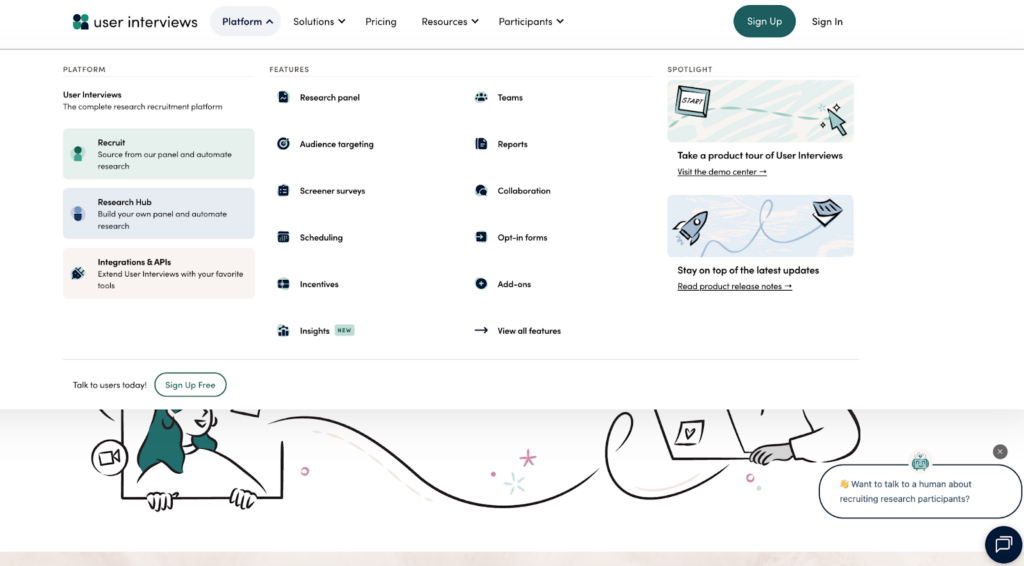
Because of its name, it’s easy to assume UserInterviews.com is a tool for running moderated interviews. In reality, it is a participant recruitment platform. Its value lies in helping teams find the right people with ease.
Where UserInterviews works well
● Access to a large, diverse participant pool through Recruit
● Strong screener filters and demographic targeting
● Automated scheduling and calendar coordination
● Built-in incentive management and payment distribution
Where Userinterviews falls short for UX research
● No live interview, video recording, or screen sharing tool
● No note-taking, tagging, or transcription features
● No usability testing capabilities
● Must be paired with another platform (Lookback, Zoom, UXArmy, etc.) to run actual sessions
Conclusion: UserInterviews is a recruitment layer, not a research platform. It supports your studies but must be paired with another tool rather than replacing one in this list.
Zoom: Great for Live Calls, But Not a UX Research Platform
Zoom is often the first tool UX teams use because it’s familiar and reliable. Many also like the live transcriptions. But it is not a user research platform.
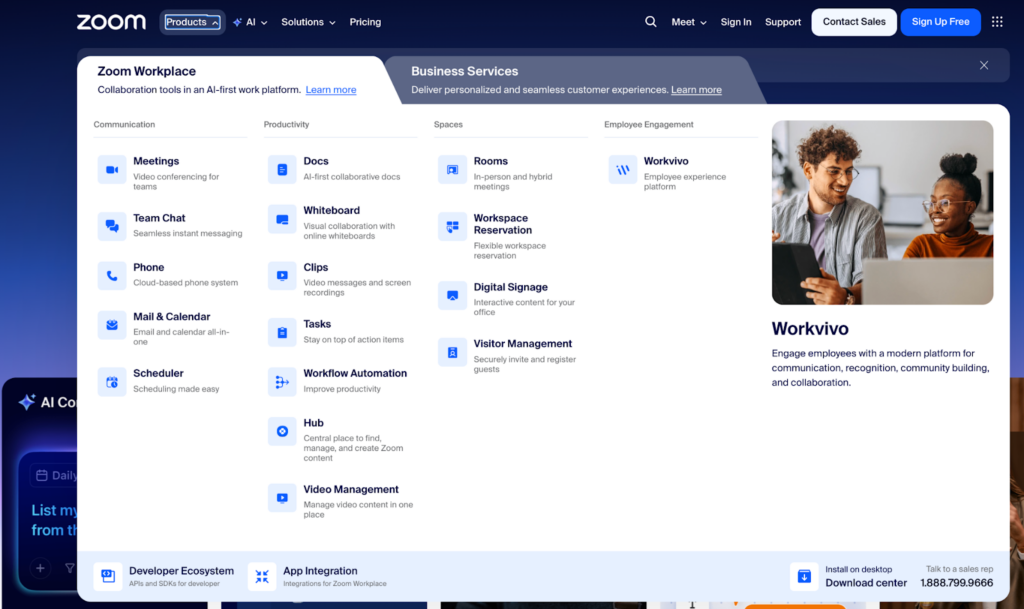
Where Zoom works well
- Live user interviews
- Quick scheduling
- No installation issues
- Screen sharing works fine
Where Zoom falls short for UX research
- No observer backchannel
- No built-in note-taking or timestamping
- No automated transcripts optimized for UX
- No tagging or highlight reel creation
- No unmoderated usability testing
- No research repository features
- No analysis workflows
Conclusion:
Zoom is a communication tool, not a research tool. Teams using it for user research often need 3 to 4 additional tools for analysis, transcription, video clipping, and synthesis.
Lookback Review 2026: Best for Moderated Interviews?
Lookback is one of the most widely recognized UX interview platforms. Its biggest strength is how it handles moderated sessions.
What Lookback does very well
- Live moderated interviews with a smooth UX
- Hidden observer room with private team chat
- Automatic session recordings
- Time-stamped notes
- Some simple unmoderated usability tests
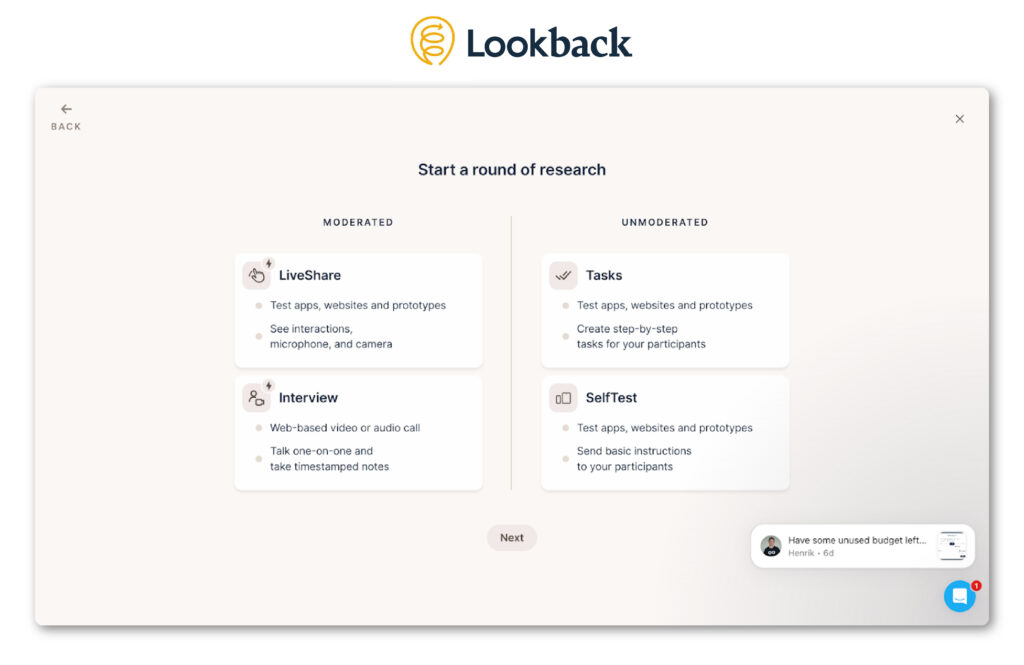
Lookback is attractive to product teams who want something purpose-built for moderated UX research instead of Zoom. The researcher needs to select between 2 user interview tools – LiveShare or Interview – depending on the device participant will be using and whether screen recording is required.
Limitations
- Analysis tools are relatively lightweight
- No interpreter audio channel for international studies
- Unmoderated testing is offered but really basic (simple tasks, no metrics even for survey style questions)
- No focus group, triad, dyad capability
- Limited multilingual support compared to newer platforms
Conclusion:
Lookback is great for moderated 1:1 interviews with hidden observers, but its analysis features – Eureka included – remain limited. Its unmoderated testing capabilities lag far behind tools like Maze, Lyssna, and UXArmy.
UXArmy: A Lookback Alternative With Focus Groups, Unmoderated Testing, and Full Analysis Workspace
UXArmy is the platform that offers the widest range of research methods – covering live interviews with hidden observers, focus group discussions, unmoderated usability testing, surveys, card sorting, and tree testing. Moderated user interviews and focus group discussions are supported on a single tool called DeepDive®. As a user, you get access to all tools.
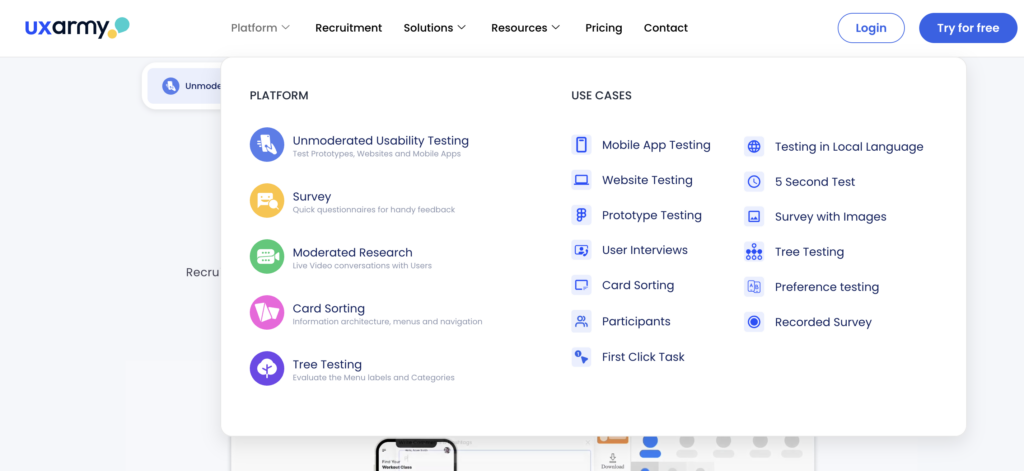
Where UXArmy stands out
1. Moderated interviews like Lookback – but with more depth
- Supports live interviews and focus groups, as well as video and audio uploads
- Includes hidden observers, consolidated note-taking, bookmark
- Up to 3-hour sessions, up to 3 participants
- Participant can switch devices (desktop and phone) within a session
- Moderated research with usability metrics (via DeepDive®+Figma testing)
- AI highlights and reels, auto-tag, synthesis in Analysis Space
2. Powerful unmoderated testing tools
- Advanced task based usability testing with logic, success criteria
- Surveys, card sorting, tree testing, usability testing
- Supports native mobile app testing, websites testing, prototype testing
- Full screen, audio, camera recordings (50 min mobile, 60 min desktop)
- Heatmaps, navigation path analysis, usability metrics, AI summaries & analysis
3. Designed for global teams and international research
- Transcription in 23 languages, tuned for regional accents for higher accuracy
- In-platform translation of transcriptions into 67 languages for fast collaboration
- Separate interpreter audio channels for moderated sessions across markets or when stakeholders from different countries join
Limitations
- More features mean a learning curve for beginners
- Strong analysis & synthesis features, but not as comprehensive as Condens’ synthesis and repository workflows
Conclusion:
UXArmy is ideal for teams wanting one unified platform for moderated interviews, unmoderated testing, analysis, and multilingual research – rather than stitching together Lookback + Condens.
Condens: Best for Analysis, Not for Running Interviews
Condens is a beloved tool in the UX community, but it’s important to understand what it does and does not do.
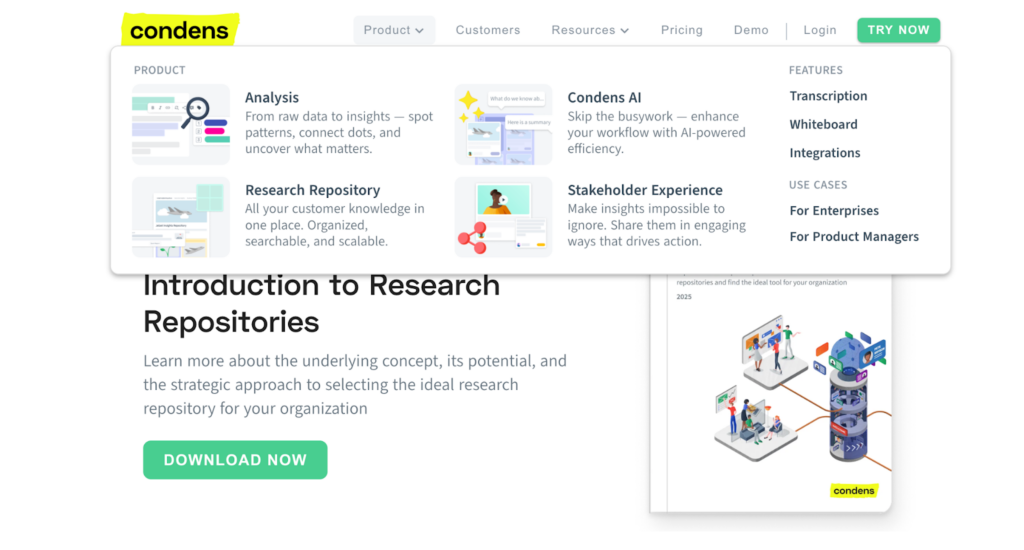
What Condens excels at
- Tagging and coding qualitative data
- Creating insights from interviews
- Building research repositories
- Synthesizing across multiple studies
- Sharing research outputs
What Condens lacks
- No live interview feature
- No built-in recording tool
- Researchers must upload external videos (e.g., from Zoom)
- No unmoderated testing
- Not suitable for real-time collaboration during sessions
Condens is best used as a post-analysis layer, often combined with another tool like Lookback or Zoom.
Conclusion:
If your pain point is organizing insights – not running interviews – Condens may be valuable.
Best User Interview Platform 2026: Decision Guide by Needs
Here’s a simple decision guide based on common user needs.
If you want an easy live interview tool, Choose Lookback or UXArmy
- Lookback for a purpose-built moderated 1:1 interview experience (note: researchers choose between LiveShare and Interview depending on device and screen recording needs). Sign in is required of participants and observers. One session, one device.
- UXArmy for interviews and focus groups in a single tool (DeepDive®), plus built-in synthesis. No sign in required. Support switching of devices mid-session for participants. UXArmy offers more flexibility vs Lookback.
If your team wants unmoderated testing too – UXArmy
Lookback’s unmoderated mode is essentially a repurposed interview tool, and does not offer usability testing features such as heatmaps, navigation path analysis, usability metrics, conditional logic. What it does offer is screen, audio, camera recording of the full test with transcription.
If you only need simple calls – Zoom
But expect to add tools for transcription, sharing, analysis, and storage. Observers are visible to participants which may intimidate the participant or compel them to be nice.
If your main challenge is analysis and repository building – Condens
But be aware you’ll need another platform for actually running the interviews.
If you need to recruit participants – UserInterviews for US
But remember, recruitment platforms all tend to have regional strengths. Think UserInterviews for the US and UK markets, UXArmy for participants from Asian markets.
If you need to recruit participants – UserInterviews for US and UK; UXArmy for AsiaUserInterviews is strongest in the US and UK, offering quick access to high-quality participants in those regions. Recruitment platforms vary by geography, however. For studies across Asia including Southeast Asia and India UXArmy’s dedicated Asia panel provides far better coverage and more reliable targeting
Frequently asked questions
What Are the Best UX Research Tools in 2026?
Top platforms include UXArmy for full-suite moderated/unmoderated testing with AI, Lookback for live interviews, and Condens for analysis repositories. Zoom suits basics but lacks UX features, while UserInterviews excels in recruiting
Lookback vs UXArmy: Which Wins for Moderated userInterviews?
UXArmy stands out by supporting longer, real-world moderated sessions (up to 3 hours), seamless device switching within a single study, and multi-language interviews via interpreter channels making it better suited for complex research and global teams. Its AI-powered synthesis accelerates insight generation across sessions, while Lookback remains more focused on lightweight 1:1 moderated interviews. Although both platforms support hidden observers, UXArmy goes further by combining moderated and unmoderated testing in one workflow, enabling teams to validate findings at scale without switching tools.
Does Condens Support Live User Interviews or Unmoderated Testing?
No, Condens focuses on post-session analysis like tagging, transcripts, and repositories; pair it with Lookback or UXArmy for interviews. It shines in synthesizing uploads but skips real-time collaboration.
Best Free Tree Testing Tool for UX Teams in 2026?
UXArmy provides free-tier tree testing tool within its unmoderated suite, including metrics and AI summaries outpacing basic tools. Compared to Optimal Workshop for standalone IA focus.
UXArmy vs Zoom for Stakeholder Observation in User Research?
UXArmy offers hidden observers with private chat and consolidated notes, unlike Zoom’s visible participants that may bias sessions. UXArmy also includes analysis, avoiding Zoom’s multi-tool needs.