



Conducting remote user interviews is one way to gather valuable insights and feedback about your product, app or website. However, what happens when the difficult participants in user interviews make the process more challenging than it needs to be?
It could be no-shows, technical difficulties, late arrivals, unengaged responses, or participants who are simply too distracted because of their chaotic environment.
Participants can spring unexpected surprises, and throw a wrench into your research plans!
In this article, let’s explore why participants may feel difficult to handle, some of the common scenarios of “difficult participants”, and tips to navigate those hurdles so that you can still gather insights without frustration.

Why do participants behave in “difficult” ways?
Certain participants might act in ways you do not expect, during user interviews. This can be due to a variety of reasons, often stemming from discomfort, miscommunication, or personal factors.
- Some participants may feel nervous or self-conscious, leading them to give short or vague responses as a defense mechanism, in fear of judgement.
- In some cases, people may not fully grasp the purpose of a user interview, thinking it’s more of a test rather than an opportunity to share their honest feedback, hence providing only politically-correct answers.
- It may also be their first time participating in a user interview, with past experiences of such interviews being in nervy, tense situations (e.g. job interviews).
- Also, the level of engagement of participants can also vary based on their perceived value of the interview. They might be there for the incentive or reward of the user interview and not so much to improve your product, hence giving you lacklustre responses.
Additionally, external factors such as distractions or technical difficulties such as poor internet connection, can exacerbate participants’ behavior and make them appear more restless and less engaged.
I hope that by sharing some of these underlying reasons, it can help fellow UX Researchers approach each unique situation with more empathy and flexibility!
Find out more about here
Common Scenarios of “Difficult” Participants
Not all user interviews go smoothly—some participants make it trickier than others. But before you get frustrated, it helps to understand why they’re acting that way.
Here are a few common “difficult” participant types and how to handle them with ease.
The (Almost) Silent One
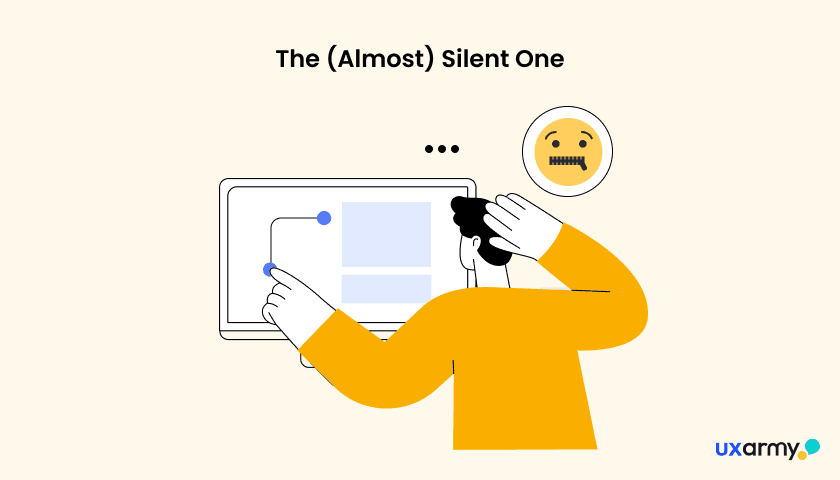
This participant responds with very minimal information, only giving you one-word answers.
“How do you feel about the product?”
“It’s good.”
They appear shy or reserved, and rarely elaborates. Occasional nods to agree with your assumptions of their thoughts.
Tip: Right from the start, make it an open and friendly environment, so that they feel encouraged to share their thoughts without the fear of judgement. Start with some ice-breaker questions, or ask about their hobbies. You can use open-ended questions often during the session to probe further.
The Distracted One
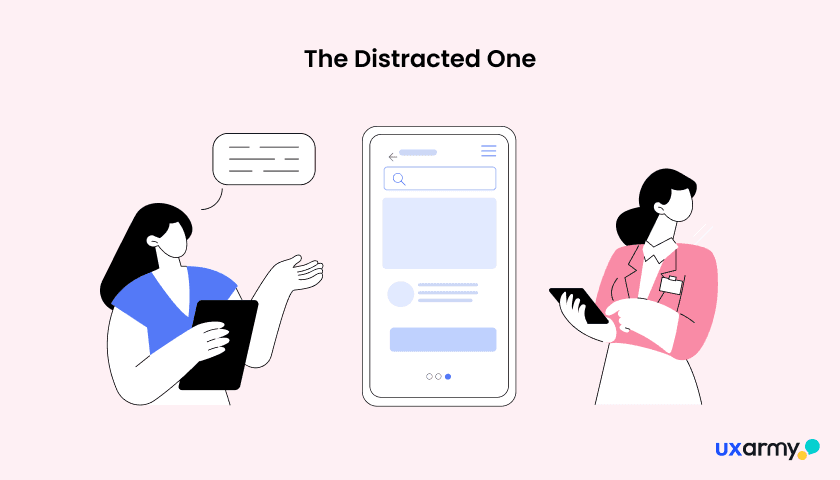
This participant is taking the user interview session from his home, with all sorts of background noise. You can hear one of his children asking permission for some gaming time.
Another participant can be clearly seen using his phone during the user interview, maybe replying to a work email, and giving you half-baked responses to the interview questions.
How should you deal with distractions or participants trying to multitask during the user interview?
Tip: Ensure that participants are in a quiet, comfortable setting before the remote user interview session starts. If distractions pop-up during the session, politely remind the participant about the importance of their input, which is to learn about their challenges or struggles so that their experience with your product can be improved. Kindly let them know that you want to make the most out of BOTH your time together.
The Talkative Expert
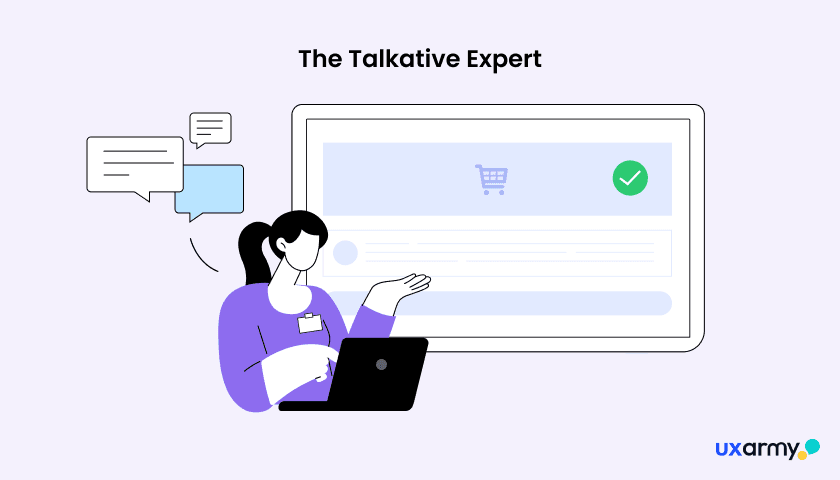
This participant has extensive knowledge of the research topic, and this leads to them over-explaining certain things and taking away your control, dominating the conversation by themselves.
The user interview goes out of track, straying too far away from what you plan to discover.
Tip: At the beginning of the user interview session, try to set some expectations about the focus of the interview, as well as the time limit. If the conversation goes out of control, acknowledge their expertise, but gently steer the participant back on track.
“That’s a valuable insight and it’s clear you have a lot of experience with this, but let’s get back to [topic of research]”.
If time allows, however, it is alright to allow participants to elaborate more. You will never know what you might uncover by giving them that extra minute to “over-elaborate”. It is a challenge and an art to get the right balance.
The Contradictory One
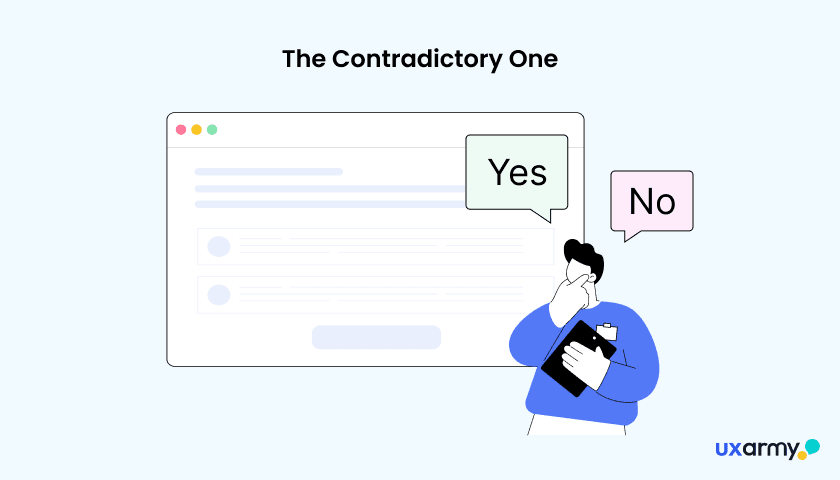
This participant provides inconsistent responses, and contradicts themself more than once during the user interview session. After an hour and a half, you ask yourself if the participant actually finds the navigation in your app easy, or not?
Tip: Gently point out their contradictions.
“Earlier, you mentioned the navigation in-app is easy but now you’re saying it is challenging. Can you help me understand what changed your mind?”
Also, for these participants, give them additional time to think through their responses after asking questions. It might help reduce any confusion or conflict in thoughts.
“Difficult” Participants Are Inevitable
We cannot expect our user interview participants to be perfect. While some participants provide valuable insights or discoveries, “difficult” participants are an inevitable part of the research process.
Understanding the reasons behind their behavior and employing the right strategies can make a difference in your research and findings. By staying patient, empathetic, and flexible, it is possible to guide even the most challenging participants toward providing valuable insights.
With some helpful tips outlined in this article, you are now better equipped to handle some of the curveballs thrown your way and ensure that your user interviews remain productive and insightful! Remember, each participant brings a unique perspective, and it’s your job as a UX researcher to create an environment where participants feel comfortable enough to share their thoughts and feedback.
If you prefer someone else to handle unexpected scenarios, UXArmy provides a versatile and speedy recruitment service where each participant is screened by qualified UX Researchers in local languages. UXArmy is able to handle all recruitment aspects for you, including the scheduling and sending of incentives in participants’ local currency. Further discussion can be arranged if you require user interview moderating services as well. Reach out to UXArmy to get the perfect participants for your research projects today.
Frequently asked questions
How to handle difficult participants?
Label the person in front of the group or in private to other participants. Become busy and focus on other things rather than listening to the person. Commentary: When confronted with any difficult behavior, we need to be able to step back and objectively assess what might be the root cause of the behavior.
Which is a key skill for handling difficult participants?
Use emotional intelligence to work with difficult colleagues effectively. Practice communication skills to work with difficult person situations confidently. Use problem-solving skills to build a positive work place environment despite challenges.
How do you handle a difficult trainee?
Below are some suggestions which may help. Ensure people attend the right course. Try never to argue or mirror aggressive behaviour. If there is a problem, address it at the first break. Actively ask others for their opinions. Don’t kill with PowerPoint! Thank people for their thoughts and move on.
How to deal with difficult people interview questions?
Show that you’re proactive by mentioning specific conflict resolution techniques, such as mediation or finding common ground. These strategies demonstrate that you don’t shy away from tough conversations. Avoid using negative language or placing blame on others; instead, focus on your role in resolving the issue.
What are common mistakes in user interviews?
Asking too many questions in a short amount of time can overwhelm the user and lead to rushed or shallow responses. Focus on a few key topics and allow the conversation to flow naturally. Quality is more important than quantity when it comes to gathering useful feedback.
What is the star method in interviewing?
The STAR method is a structured approach for answering behavioral interview questions, standing for Situation, Task, Action, and Result. It provides a framework to tell a compelling story, giving context, defining the challenge, detailing your specific actions, and highlighting a positive outcome or what you learned. This method helps you give clear, concise, and concrete answers to questions about past performance and how you’ve handled different situation