



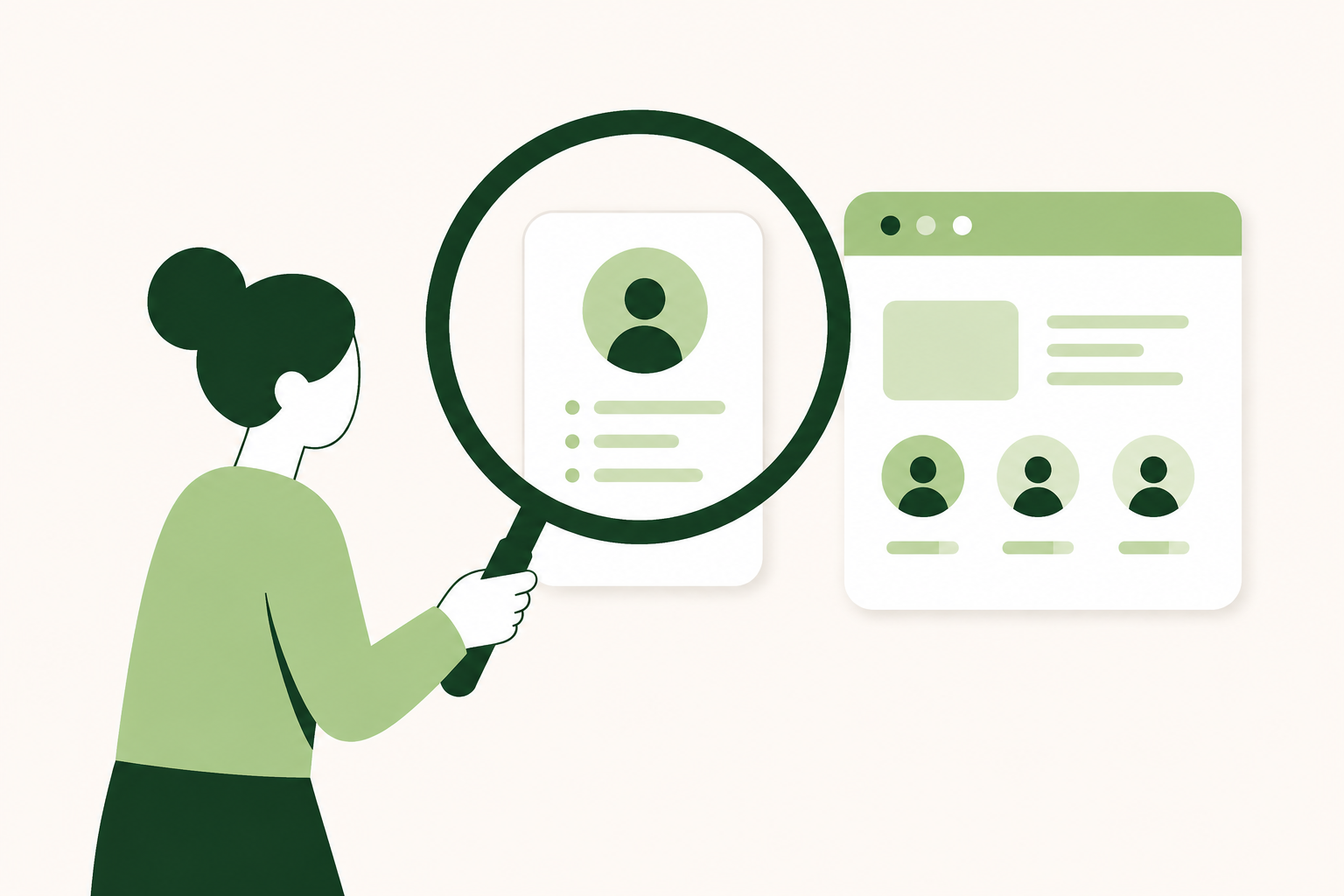
UX research principles are the foundational standards that make user research trustworthy, repeatable, and useful for product decisions. They include conducting research with real users, combining qualitative and quantitative methods, testing continuously rather than once, sharing findings in formats that drive action, and aligning every study with a clear decision. Following these principles is the difference between research that changes a product and research that fills a slide deck nobody opens.
Why UX Research Principles Matter More Than Any Single Method
A team can run interviews, surveys, usability tests, and card sorts, and still produce findings that go nowhere if the underlying principles are weak. Knowing why you chose it, who you tested with, and what you will do with the result is what separates useful research from expensive documentation.
Nielsen Norman Group defines usability as a quality attribute assessed by five components: learnability, efficiency, memorability, errors, and satisfaction. Those five components do not care which tool you used to measure them. They care whether the research was designed well enough to reveal the truth. That is what principles protect.
The Core UX Research Principles That Produce Better Products
These are not abstract ideals. Each principle has a direct, practical effect on the quality of your findings and the decisions your team makes from them.
1. Research the Problem Before You Research the Solution
Start with what users are trying to accomplish, not whether they like a particular design. A study that opens with “do you like this button” has already skipped the harder question: does the user understand what the button is for, and does it solve a problem they actually have. Premature focus on a solution biases everything learned afterward, because participants react to what is in front of them instead of revealing what they actually need.
2. Trust What Users Do Over What Users Say
Behavioral data is more reliable than self reported data. Watching someone attempt a task reveals gaps that a Likert scale question never will. This holds especially for future intent: ask about a specific past instance, such as “tell me about the last time you tried to do this,” rather than a hypothetical, such as “would you use a feature that does this.” People are consistently bad at predicting their own future behavior, but they describe what actually happened with reasonable accuracy.
Laura Klein, author of Build Better Products and Principal Experience Specialist at Nielsen Norman Group, addressed this on the UXArmy User Insights podcast. She warns against the “feature factory” trap, where teams ship based on what users claim they want rather than validating it against what users actually do. Her guidance: use quantitative research to uncover what is happening, and qualitative research to diagnose why it is happening, rather than relying on stated preference in place of either.
For a deeper look at balancing both approaches, UXArmy’s guide on quantitative vs. qualitative research breaks down when to use each.
Try UXArmy for free, set up your first usability test in minutes, and apply these principles in your next study.
3. Recruit for the Right Sample, Not the Easy Sample
A handful of the wrong participants, colleagues, convenience samples, or a non representative panel, will actively mislead you, not just fail to help. Screener quality matters as much as sample size. A perfectly designed study with the wrong people produces confident, wrong answers, more dangerous than no answer because they get acted on.
Recruiting the right participants is the single highest impact decision in any study. When Agoda needed to understand how Chinese and Japanese speaking users in Singapore interacted with their travel booking site, they did not test with English speakers and translate the findings afterward. UXArmy recruited native speakers and conducted the research in Mandarin and Japanese, surfacing usability problems invisible to an English only study with a convenient sample.
4. Match Sample Size to the Question, Not the Budget
Five to eight users per segment is enough to surface the majority of usability issues in a qualitative study, Jakob Nielsen’s classic and still widely applied finding. That number only holds for qualitative work aimed at finding problems, not for measuring anything numerically. If you need a conversion rate, a satisfaction score, or any statistic you intend to generalize, Nielsen Norman Group recommends around 40 participants for real statistical power. Applying the 5 user rule to a quantitative question, or recruiting 40 people for a discovery study, both waste resources by mismatching method to goal.
Ready to apply these principles in your next study? Try UXArmy for free and set up your first usability test in minutes.
5. Triangulate Methods Instead of Trusting One
No single method tells the whole story. Combine attitudinal research (interviews, surveys) with behavioral research (usability tests, analytics), and generative research (open exploration) with evaluative research (validating a specific concept). Each axis compensates for what the other misses.
In practice, this looks like pairing analytics, which showed a 40% drop at checkout, with usability testing, which showed users were confused by a shipping cost that appeared too late. Neither method alone would have produced both the signal and the explanation. UXArmy’s guide on generative versus evaluative research breaks down when each type earns its place in a research plan.
6. Guard Against Leading Questions and Confirmation Bias
It is easy to unconsciously design a study that validates what your team already believes. “Did you find the checkout confusing?” tells the participant what answer is expected. “Walk me through what happened when you tried to complete the purchase” does not. Neutral wording, blind facilitation, and stating your hypothesis before you collect data all guard against a team seeing what it wants to see.
7. Separate the Raw Data From Your Interpretation
Capture verbatims, recordings, and observed behaviors as they happened, before you synthesize anything. Skipping straight to “themes” without preserving the underlying evidence makes it impossible to check your own bias later, and it makes a skeptical stakeholder’s question, “can I see what the user actually said,” impossible to answer. UXArmy’s AI powered analysis generates timestamped transcripts automatically, keeping the original evidence attached to every finding.
8. Treat Research as Continuous, Not a Single Gate
The best organizations weave research into every stage: discovery, concept validation, usability testing, and post launch tracking, rather than treating it as one checkpoint before launch. The ISO 9241 standard for human centered design formalizes this, requiring iterative evaluation with users throughout the process, not a single validation at the end.
Example: A food delivery app tests its checkout flow before launch and catches three issues. After launch, monthly testing reveals a promotional banner obscures the address field on smaller screens, a problem a single pre launch gate would never have caught.
Need help setting up a research cadence? Book a demo with UXArmy to see how teams run continuous research without a dedicated research department.
9. Make Every Insight Actionable, or It Is Trivia
A finding that does not translate into a decision, a design change, or a prioritization call is trivia, not insight. Good research output is framed around what the team should do differently, not what was merely observed.
Arvind Chandrashekar, Director of User Research at Glance, addressed this on the UXArmy User Insights podcast episode on communicating the ROI of UX research. He emphasizes that researchers must align research with business objectives and convey insights through storytelling, not slide decks, to make findings stick. A research planning template that forces you to state the decision a study will inform, before you run it, keeps every study accountable to an action rather than a report.
10. Protect Participant Trust
Informed consent, data privacy, and not overpromising compensation or outcomes are not just compliance boxes. They are what keeps future recruitment viable. A participant who feels misled will not return, and word travels fast within tight professional communities, particularly in B2B research where the pool of qualified participants is already small.
11. Say No to Research That Will Not Change a Decision
If leadership has already committed regardless of outcome, running the study anyway wastes participant goodwill and team time on research theater, the appearance of rigor without any real influence on the decision. Good researchers push back before the study starts, not after the findings are ignored. This is the least comfortable principle here, and the one most often skipped, because saying no requires confidence that an overworked researcher rarely has room for.
How to Conduct User Research That Actually Drives Decisions
These five practices turn them into a repeatable process for conducting user research that UX teams can follow every sprint.
Practice 1: Write the Decision Before Writing the Script
If you cannot name the decision the study will inform, you are not ready to run it. “Should we combine shipping and billing into one step?” produces a focused study. “Learn about checkout” produces 40 pages of observations and no action.
Example: A fintech team frames its study as “does biometric login reduce drop-off at authentication for users over 50?” That question shapes the recruit, the tasks, and the analysis.
Practice 2: Recruit for Behavior, Not Just Demographics
Demographics get you a profile. Behavioral screening gets you someone whose actions mirror your real users.
Example: A food delivery app screens for “ordered takeout online at least twice in the past week” rather than “aged 25 to 40 in urban areas.” The behavioral filter surfaces participants whose habits match the product context.
Practice 3: Keep Studies Small and Frequent
Five users per round surface about 85% of usability problems. Run a round every sprint rather than a large study every quarter. Small, frequent tests build a rhythm where research informs the next sprint, not the next annual review.
Example: A SaaS team tests its onboarding flow with six users every two weeks. Sprint 1 reveals that users miss the “skip” button. Sprint 2 confirms the redesigned button works. The fix ships in three weeks, not three months.
Practice 4: Debrief Within 48 Hours
Insights lose urgency fast. Share the top three findings within two days while the team still remembers the questions that prompted the study. A finding delivered a month later competes with new priorities and rarely wins.
Example: After a Thursday usability session, the researcher shares a two-minute highlight reel and three bullet points in the Friday standup. By Monday, the designer has a revised wireframe. That speed is what makes research feel useful rather than academic.
Practice 5: Close the Loop by Retesting After the Fix Ships
A fix that ships untested is an assumption dressed as a solution. After every research-driven change, retest with fresh users. This is how to conduct user research UX teams trust over time.
Example: A banking app finds users abandon bill payments because the confirmation screen lacks a summary. The team adds one. A retest two weeks later shows completion rates rise from 62% to 89%.
Book a demo with UXArmy to see how teams run continuous research without a dedicated research department.
Frequently Asked Questions
How Do You Measure Whether UX Research Is Working?
Track two things: how many studies led to a product decision within 30 days, and whether the metrics those decisions targeted actually improved. Research that does not change a decision or move a metric needs a different question, not a bigger sample.
What Is the Minimum Team Size to Run Effective UX Research?
One person with the right tools can run effective studies. A solo researcher or product manager using a platform like UXArmy can recruit participants, run unmoderated tests, and analyze results without a dedicated research team. The bottleneck is usually process, not headcount.
How Do You Handle Stakeholders Who Dismiss Research Findings?
Lead with observed behavior, not opinions. Show a 90-second clip of a real user failing at the task your stakeholder assumed was easy. Behavioral evidence is harder to dismiss than a chart. Frame findings around business risk: this is what users cannot do, and this is what it costs us.
Should You Use AI in UX Research?
AI is useful for transcription, tagging, sentiment analysis, and initial synthesis. It is not a substitute for study design, participant selection, or interpreting what a finding means for the product. Use AI for speed on the repetitive work and human judgment for the decisions that matter.