


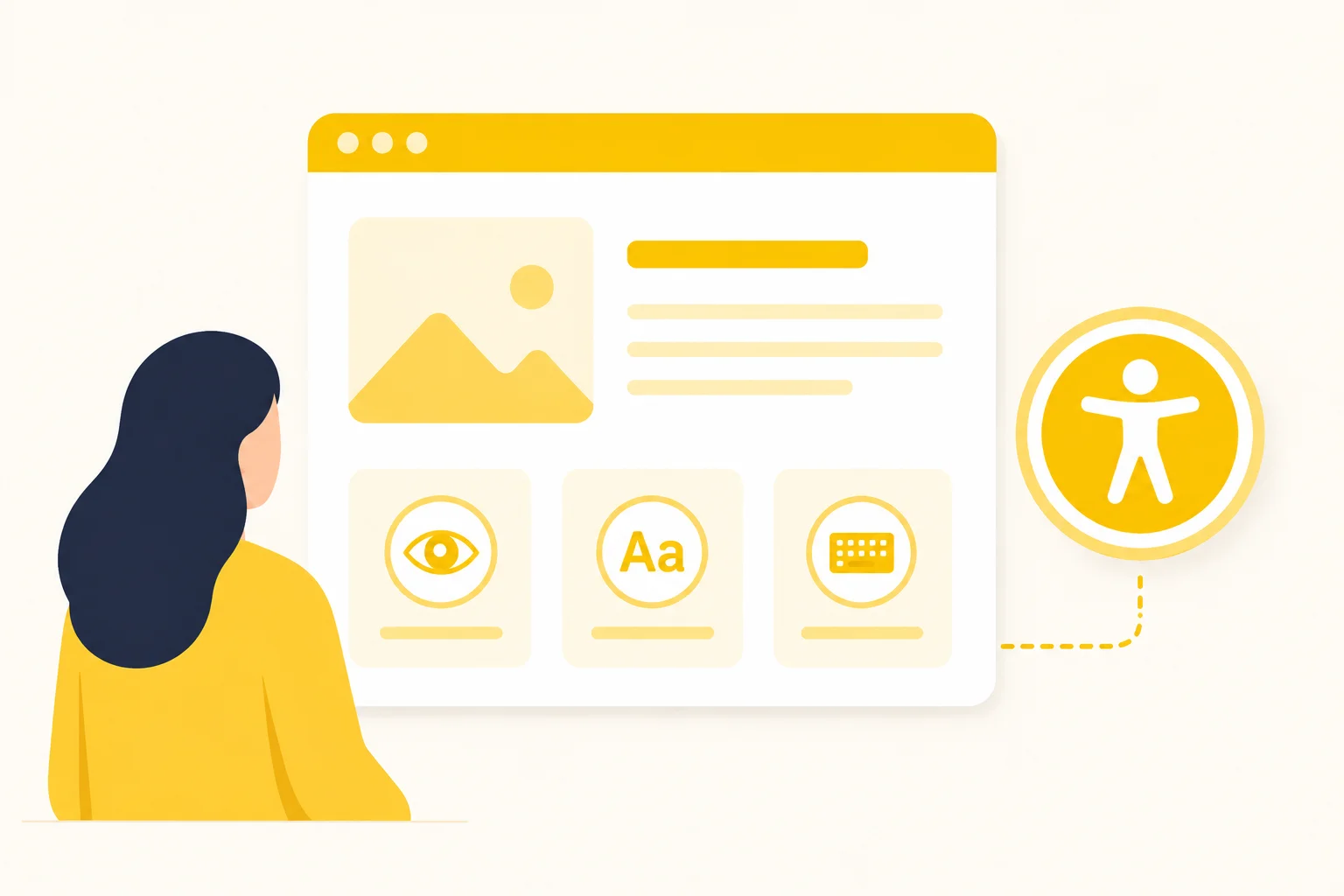
Website accessibility best practices are the design, code, and content standards that let people with disabilities use your site. The core set includes sufficient color contrast, descriptive alt text, labeled forms, full keyboard navigation, clear headings, captioned media, and testing with real users. Most map to WCAG 2.1 Level AA, the standard U.S. regulators and courts now reference. Following them widens your audience to the roughly 1.3 billion people living with a disability, and lowers legal risk by aligning with the WCAG 2.1 AA standard used in ADA lawsuits.
Key takeaways
- 95.9% of the top one million home pages had detectable WCAG failures in 2026, so most businesses start from a position of non-compliance (WebAIM, 2026).
- An estimated 1.3 billion people, about 16% of the world or 1 in 6, live with a significant disability and may struggle with an inaccessible site (WHO, 2024).
- Six issues cause 96% of all detected errors: low-contrast text, missing alt text, unlabeled form fields, empty links, empty buttons, and missing page language. Fix these first for the biggest gain.
- WCAG 2.1 Level AA is the technical standard the U.S. Department of Justice adopted in 2024 and the benchmark plaintiffs use in ADA lawsuits.
- In the EU, the European Accessibility Act has required businesses serving EU customers to meet accessibility standards since 28 June 2025, enforced through the technical standard EN 301 549, which incorporates WCAG 2.1 Level AA.
- Automated checkers catch only part of the picture. WebAIM states that the absence of detected errors does not mean a page is accessible. Real-user testing finds the rest.
What is Web Accessibility?
Web accessibility means building websites so people with disabilities can perceive, understand, navigate, and interact with them. This covers visual, hearing, motor, cognitive, and neurological disabilities. The recognized framework is the W3C’s Web Content Accessibility Guidelines, known as WCAG.
Accessibility for websites also helps people who do not identify as disabled. Captions help someone in a loud room. High contrast helps someone reading in bright sunlight. Clear navigation helps everyone on a small screen or a slow connection.
Why Does Website Accessibility Matter for Businesses in 2026?
Two reasons: reach and risk.
On reach, the World Health Organization estimates that 1.3 billion people, around 16% of the global population, live with a significant disability. An inaccessible site turns that audience away before they reach your product.
On risk, the gap is wide and getting wider. According to the WebAIM Million 2026 report, 95.9% of the top one million website home pages had detectable WCAG failures, meaning fewer than 1 in 20 passed an automated check. That figure rose from 94.8% the year before, reversing six years of slow progress. WebAIM links the decline to heavier, more complex pages and to AI tools that build websites quickly while introducing accessibility problems along the way.
The legal picture sharpened too. The Department of Justice’s 2024 web accessibility rule set WCAG 2.1 Level AA as the standard for state and local governments. Private businesses are not bound by that specific rule, but courts and plaintiffs treat WCAG 2.1 AA as the practical benchmark in ADA lawsuits, which continue to rise each year.
15 Website Accessibility Best Practices
Here is the working checklist to make your website accessible in 2026. The first fourteen are technical and content fixes. The fifteenth is the one most teams skip, and it is the one that catches what the others miss.
- Target WCAG 2.1 Level AA. Treat it as your baseline, not a stretch goal. It is the standard regulators and courts reference.
- Fix color contrast. Low-contrast text is the most common failure, found on 83.9% of home pages. Aim for a 4.5:1 ratio for normal text and 3:1 for large text.
- Write descriptive alt text. More than half of home pages (53.1%) have missing alt text. Describe what the image shows or does, and use empty alt for decorative images.
- Label every form field. Roughly one in three form inputs is unlabeled. Connect a visible label to each field so screen readers announce its purpose.
- Make everything keyboard-operable. Every link, button, and field must work without a mouse. Test by tabbing through the page from top to bottom.
- Give links and buttons real names. Empty links appear on 46.3% of pages and empty buttons on 30.6%. Avoid “click here” and label icon buttons.
- Use a logical heading structure. Do not skip levels. Screen reader users navigate by headings, yet 41.8% of pages skip heading levels.
- Set the page language. A missing language attribute, still present on 13.5% of pages, breaks pronunciation for screen readers. Add it in one line.
- Show a visible focus indicator. Keyboard users need to see where they are. Never remove the focus outline without replacing it.
- Caption video and transcribe audio. Captions and transcripts serve deaf and hard-of-hearing users, and they double as searchable text.
- Do not rely on color alone. Pair color with text or icons so colorblind users get the message. Mark errors with words, not just red.
- Add a working skip-navigation link. Let keyboard users jump past the menu. Check that it works, because one in ten skip links is broken.
- Use ARIA sparingly. Use native HTML first. Pages with ARIA averaged more errors than pages without it, usually from incorrect implementation.
- Support zoom and resizing. Content must stay usable at 200% zoom and reflow on small screens without horizontal scrolling.
- Test with real users, including people with disabilities. The first fourteen practices get you to a clean automated scan. They do not tell you whether a blind user can finish checkout or whether a low-vision user abandons at step three. Only watching real people, including people who use screen readers, switches, or magnification, reveals that. This is the practice that separates a site that passes a tool from a site that actually works.
Why Automated Accessibility Checkers are not Enough
Automated tools are useful, and you should run them. But they have a hard limit, stated plainly by WebAIM: the absence of detected errors does not indicate that a page is accessible or conformant. Tools catch mechanical issues like missing alt text. They cannot judge whether your alt text is meaningful, whether your checkout flow is usable with a keyboard, or whether your error messages make sense to a screen reader user.
That judgment requires people. Watching someone with a disability attempt a real task surfaces the barriers a scanner reports as clean. Moderated usability testing lets you observe those sessions live and ask follow-up questions. Unmoderated usability testing scales the same insight across more participants when you need breadth.
UXArmy supports this directly. You can run website usability testing with screen and audio recording, then recruit participants who match your audience using screeners and a panel spanning more than 20 countries. The platform records what users do and say, so you see the moment someone gets stuck rather than guessing from a checklist.
Want to see where real users get stuck on your site? Start a free UXArmy trial and run your first accessibility-focused test this week.
FAQs on Website Accessibility Best Practices
How much does it cost to make a website accessible?
It depends on your starting point. Fixing the six most common issues, which cause 96% of detected errors, is low-cost and often a few days of developer time. Deeper work, like rebuilding a checkout flow or running user testing, costs more but prevents expensive rework and legal exposure later.
Do accessibility overlay widgets make my site compliant?
No. Overlay widgets that promise instant compliance do not fix the underlying code, and many introduce new barriers for screen reader users. They are not a substitute for accessible design and have been named in accessibility lawsuits.
Is my small business legally required to have an accessible website?
The 2024 DOJ rule applies to state and local governments, not private businesses. That said, ADA Title III lawsuits against private companies are common, and they use WCAG 2.1 Level AA as the benchmark. This is general information, not legal advice. Confirm your obligations with a qualified attorney.
How many participants do I need for accessibility testing?
Around five to seven participants per group surfaces most major usability issues. For accessibility specifically, recruit users who rely on assistive technology, such as screen readers or keyboard-only navigation, rather than testing only with non-disabled users.
How often should I test website accessibility?
Test before any major launch or redesign, and re-check after significant changes. Because home page complexity grew 22.5% in a single year, sites drift out of compliance as new features ship, so treat accessibility as ongoing rather than a one-time audit.