



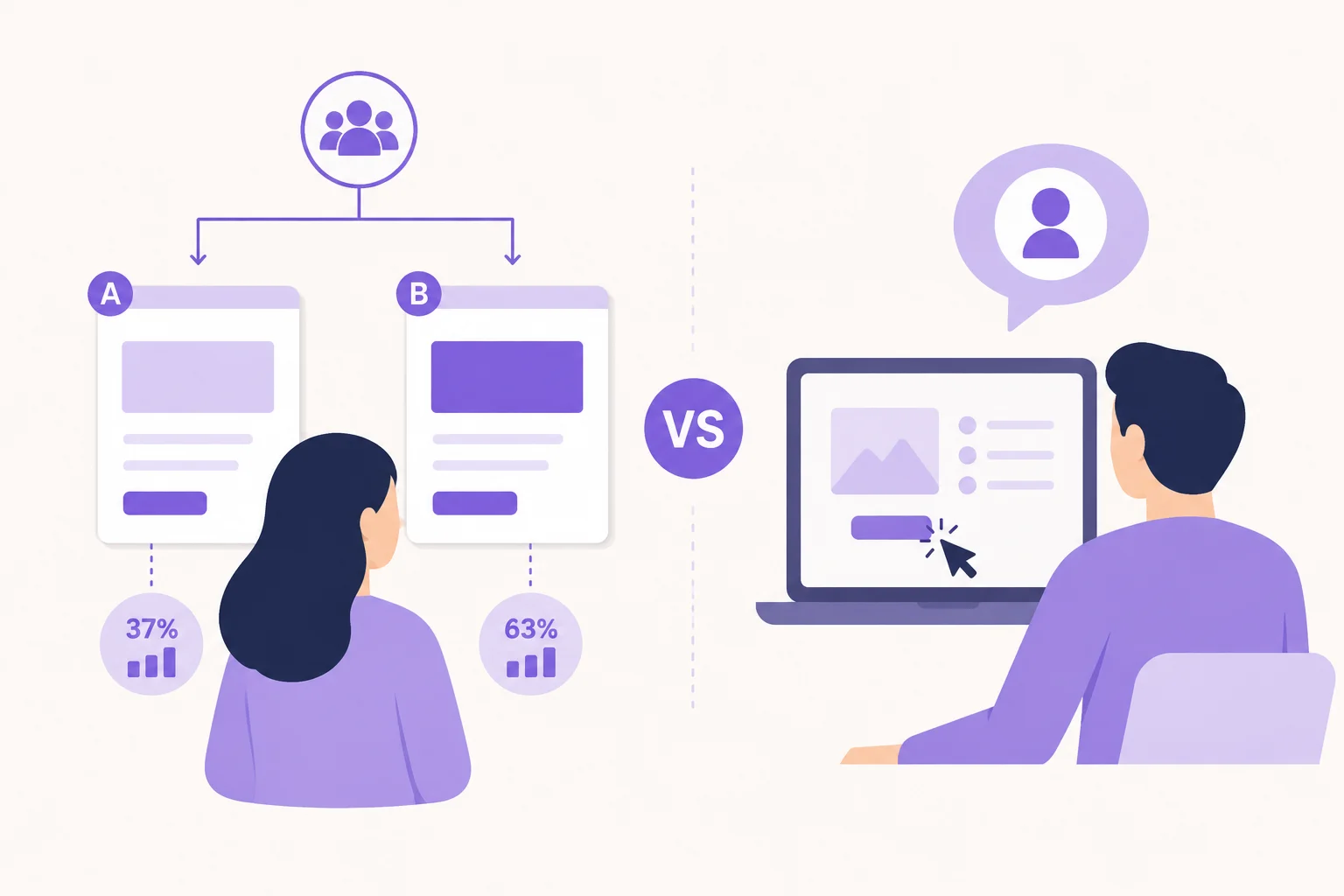
A/B testing and usability testing answer different questions. A/B testing is a quantitative method that compares two versions of a page or feature with live traffic to see which performs better on a metric. Usability testing watches real people use a product to find where and why they struggle, most often qualitatively though it can also be run at scale for metrics. In short, A/B testing tells you what happened, and usability testing tells you the user intent behind it.
The two are not competing options. Teams can use usability testing to understand user problems and inform design hypotheses, then use A/B testing to measure how a validated change performs with a larger audience.
- A/B testing measures which version performs better. It compares variants of a live experience using quantitative metrics such as conversion rate or click-through rate.
- Usability testing identifies how and why users struggle. Participants attempt realistic tasks while researchers observe their behavior and collect feedback.
- A/B testing is quantitative, while usability testing can be qualitative or quantitative. Qualitative usability testing explains behavior. Quantitative usability testing measures task performance using metrics such as success rate and time on task.
- Sample requirements differ by orders of magnitude. A/B testing needs enough live traffic to reach statistical significance. Usability testing surfaces most major issues with a handful of participants per round.
- Neither method covers the other’s blind spot, so sequence beats preference. A/B testing validates a change you already thought of but cannot say why it won. Usability testing surfaces problems you did not know existed. Run usability testing early to find and explain issues, then A/B testing to confirm which fix wins at scale.
- The two methods usually live in different tools. A/B tests run on experimentation platforms wired into your live site. Usability tests run on research platforms that recruit participants and record sessions. Most teams end up with both, and neither category replaces the other.
What is A/B Testing?
A/B testing, sometimes called split testing, shows version A to one group of users and version B to another, then measures which one drives a better result on a chosen metric such as clicks, sign-ups, or purchases. Because it runs on live traffic with real users, it replaces opinion with observed behavior.
For example, an e-commerce team might test two versions of a product page. Version A uses a prominent “Buy Now” button, while Version B changes the button label and moves it up the page. The team then compares a defined outcome, such as completed purchases or add-to-cart rate, to see whether the change had a measurable effect. The method extends to multivariate testing, where several elements vary at once, but the underlying logic and the limitations stay the same.
A/B testing is most useful when a team has a specific hypothesis and an implemented experience that can be tested with real users at scale.
Strengths and limitations of A/B testing
| Strengths | Limitations |
|---|---|
| Measures real behavior, not stated preference | Needs a single countable outcome, which rules out brand perception, trust, and comprehension |
| Detects very small differences with statistical confidence, given enough traffic | Needs fully implemented variants, so every idea costs engineering time before it teaches you anything. Not suited for testing early concepts or static designs. |
| Validates changes to conversion flows, content, navigation, and calls to action. Settles close calls qualitative research cannot. | Favors short-term metrics. A promo banner can lift clicks this week and cost you return visits next quarter. If neither variant addresses the underlying user problem, an A/B test may still identify a winner without revealing that deeper issue. |
| Cheap to run once variants exist, with no specialist observation | Names the winner but not the reason, and only for the element you varied |
Web traffic is the constraint most teams hit first. Products with low volume, long sales cycles, or small B2B audiences often cannot reach a reliable result at all. That is a reason to pick a different method, not to run the test anyway.
For a step-by-step walkthrough of setting up experiments, choosing metrics, and reading results, see our full guide to A/B testing.
What is Usability Testing?
Usability testing means watching real people attempt real tasks on your product and noting where they hesitate, get confused, or give up. The goal is to understand the reasons behind their behavior, not just the outcome.
It can be run at any stage of product development, including in the early stages with a prototype before a line of production code exists, requiring only a few participants per round. For example, a team designing a new checkout flow could ask participants to find a product, add it to their cart, and complete the purchase using a prototype. Observing where participants hesitate, make errors, or abandon the task reveals problems with the flow before it reaches a larger audience, and before engineering time has been spent building it.
You can run it as unmoderated usability testing, where participants complete tasks on their own while the session records, or as moderated research, where a researcher probes decisions live.
Usability testing is usually described as qualitative, and that is how most teams run it. It can also be run quantitatively with a larger sample to measure task success rate, time on task, or error rate with statistical confidence. Our guide to quantitative usability testing methods covers this in detail.
Usability testing is best suited to questions such as: “Can users complete this task, where do they struggle, and why?”
Strengths and limitations of Usability testing
| Strengths | Limitations |
|---|---|
| Explains why users behave as they do, which is what a team needs before it can fix anything | Small samples cannot prove metric impact or revenue lift |
| Runs at any stage of product development, including sketches and prototypes, so bad directions get caught before they are built | Depends on task design, and a leading task produces confident but wrong conclusions |
| Surfaces problems nobody thought to test for, including trust and comprehension issues | Findings need interpretation. AI can speed up synthesis, but someone still has to decide what the behavior means. |
| Needs no live traffic, so it works for pre-launch products and low-volume B2B tools | Cannot settle a close call between two versions of a design the way an A/B test can |
Read side by side, the limitations are near mirror images of each other. A/B testing measures precisely without explaining, and usability testing explains without measuring at scale.
A/B Testing vs Usability Testing: Key Differences
The table below covers the dimensions that usually decide the choice.
| Dimension | A/B Testing | Usability Testing |
|---|---|---|
| Primary question it answers | Which version performs better? | Where and why do users struggle? |
| Data type | Quantitative | Qualitative, or quantitative at larger samples |
| Sample size | Usually a large pool of users or visitors | Usually a smaller, targeted group of participants, or larger for quantitative studies |
| Testing requirements | A live product, meaningful traffic, and both variations fully built | A task, a prototype or live product, and access to representative participants |
| Stage in the development cycle | Post-launch, or late-stage validation of a finished build | Any stage, including early concepts, prototypes, or live products |
| Speed to insight | Depends on traffic, test duration, and the size of the expected effect | Qualitative findings can often emerge after a relatively small number of sessions |
| Typical metrics | Conversion rate, click-through rate, revenue, retention, or other behavioral metrics | Task success, time on task, errors, observations, and participant feedback |
| Best for | Validating a specific change at scale | Finding and explaining problems, including ones you did not anticipate |
The choice is not about which method is better, but what your real project situation requires. It comes down to what stage you are at, how much traffic you have, and how fast you need an answer.
The methods therefore provide different types of evidence rather than competing forms of the same evidence.
When Should You Use A/B Testing vs Usability Testing?
Choose the method based on the decision you need to make, the maturity of the experience, and the evidence you need.
Use A/B testing when
- You have a specific variation ready to compare, and a clear hypothesis about why it should win.
- You have enough live traffic to reach a valid result in a reasonable window.
- You want to prove impact on a single, countable metric.
- You need to settle a close trade-off between two defensible designs that qualitative research could not resolve.
Use usability testing when
- You’re early in design, or working from a prototype or live website with low traffic volume.
- You need to understand why users behave a certain way, not just that they do.
- You do not have the traffic for a statistically valid experiment, which is common for B2B products and new launches.
- A metric moved and the numbers cannot tell you what changed for users.
Use both methods when
- You’re redesigning something that already has traffic, so you can diagnose qualitatively and then measure the fix at scale.
- The stakes are high enough that a winning variation is not enough. You need to know why it won before rolling it out further.
- An experiment came back flat or negative and nobody can explain the result.
- You are building a case for a change that needs both a reason and a number, which is common when the decision goes to a stakeholder outside the team.
A Simple Decision Framework
| If your question is… | Consider.. |
|---|---|
| “Why are users dropping off here?” | Usability Testing |
| “Can users complete this new flow?” | Usability Testing |
| “Can users complete the tasks in this prototype before we build the real experience?” | Usability testing |
| “Which of these two versions performs better?” | A/B testing |
| “Did our fix actually move the metric?” | A/B testing |
| “Which version produces more clicks or completed tasks?” | A/B testing |
| “We know there is a problem, but don’t know why.” | Usability testing first |
| “We understand the problem and have two solutions to compare.” | A/B testing may be appropriate if testing at scale |
| “We need to understand the problem and then measure the impact of the solution.” | Use both |
For copy-level decisions specifically, where A/B testing is often reached for by default, there are faster methods that give you more explanation per dollar. Our guide to UX writing testing methods covers five of them.
Common Pitfalls to Avoid for A/B Testing and Usability Testing
Most of the damage comes from running the right method at the wrong moment, or from reading more into a result than it can support.
- Experimenting when you should be diagnosing. Running an A/B test to fix a problem you have not diagnosed just pits two guesses against each other. If your sign-up rate falls and you do not know why, no number of variations will tell you what confused people in the first place. Diagnose with a few users, design a real fix, then run the experiment to confirm it works for your larger user base.
- Stopping a test the moment it looks significant. Checking results daily and calling the winner as soon as the line crosses inflates your false positive rate substantially. Set the sample size and duration before the test starts, then leave it alone.
- Treating five participants as a universal rule. Five is a rule of thumb for finding major issues in a single flow with one user group. It is not a sample size for comparing segments, benchmarking against a competitor, or producing a task success rate you plan to report as a number.
- Optimizing details while a structural problem sits untouched. An A/B test always returns a winner, even when neither variant addresses the real issue. Measuring the live impact of design changes is valuable, but it tends to create a focus on short-term improvements that neglects bigger issues only qualitative studies can find, such as users not trusting the site or not understanding the product.
- Optimizing a single metric in isolation. A variation can lift the number you chose to watch while quietly costing you something you did not measure. Checkout conversion can rise while returns or support tickets rise with it. Decide up front which secondary metrics would make a win not worth having, and track those too.
- Testing too many ideas without a clear hypothesis. Running variations because the tool makes it cheap produces winners you cannot explain and cannot build on. A hypothesis states what you expect to change, for whom, and why. Without one, a positive result tells you almost nothing about what to do next.
- Choosing the method based on what is easiest to run. Teams with an experimentation platform already wired in tend to reach for an A/B test, and teams with a research panel tend to reach for sessions. Convenience is a real constraint, but it should not decide the method when the question calls for the other one.
- Writing leading tasks. “Find the discount code field in the checkout” tells the participant the field exists and roughly where to look. “Complete this purchase using the code from the email” tests what you actually want to know.
How A/B Testing and Usability Testing Work Together
The methods are strongest in sequence. Nielsen Norman Group puts the case plainly: when A/B tests run in place of research, the variations being tested are essentially guesses. Research tells you what to vary, and the experiment tells you whether the change worked.
A typical workflow might look like this
Identify a problem → Research with users → Form a hypothesis → Design a solution → Test and refine → Implement → A/B test → Measure impact → Iterate
For example, analytics might reveal that users are abandoning a checkout flow. Usability testing can then help the team understand what is causing the problem. If users struggle to understand shipping options, the team can redesign that part of the flow and test the revised experience with users before launch. Once the solution is implemented, an A/B test can determine whether the revised experience improves the chosen business metric compared with the original.
This approach combines different types of evidence:
- Analytics: What are users doing at scale?
- Usability testing: What are users experiencing, and why?
- A/B testing: Does this particular change produce a measurable improvement?
Is A/B testing better than usability testing?
Neither method is inherently better. They answer different questions. A/B testing is useful for comparing implemented alternatives against a defined metric, while usability testing helps identify where users struggle and understand why. The right method depends on the decision the team needs to make.
Is A/B testing a usability testing method?
No. A/B testing is a quantitative experimentation method. The two get grouped together because both sit under UX research and both involve real users, but they produce different things. Usability testing explains where individuals struggle. A/B testing reports which version won. It can confirm a usability fix worked, but it cannot find the problem.
Can you A/B test a prototype?
Not meaningfully. A/B testing needs live traffic split between two working versions, so it requires a shipped build. For prototypes, usability testing and preference testing are the equivalents, and both work weeks before there is anything to experiment on.
How many users do you need for A/B testing vs usability testing?
There is no single participant number that applies to every study. A/B test requirements depend on factors such as baseline conversion, expected effect size, traffic, and the desired level of statistical confidence. Qualitative usability testing can uncover important issues with relatively small samples, while quantitative usability studies require a study design and sample size appropriate to the metrics being measured.
For quantitative usability research, see UXArmy’s guide to quantitative usability testing methods.
Which is more expensive, usability testing or A/B Testing?
They cost in different currencies. A/B testing spends engineering time building variants that may lose. Usability testing spends research time on task design and analysis, plus participant incentives. For a single decision, usability testing is usually cheaper. At scale, the experimentation platform and the engineering overhead make A/B testing the larger line item.
What is the difference between A/B testing and multivariate testing?
A/B testing compares two versions that differ in one element. Multivariate testing varies several elements at once and measures every combination. Multivariate needs substantially more traffic, since the sample splits across more cells. Nielsen Norman Group’s guide to multivariate testing covers when each is appropriate.
What platforms do you use to run A/B Testing or usability testing?
They are usually separate purchases, because the two methods need different infrastructure. A/B tests run on experimentation platforms that split live traffic and track conversions, and these are typically wired into your site or app by engineering. Usability tests run on research platforms that recruit participants, host tasks, and record sessions. UXArmy is a research platform in the second category, so it covers usability testing rather than A/B testing. Our guide to A/B testing lists the experimentation tools commonly used for the first.
Can usability testing replace A/B testing?
No, and the reverse is also false. Usability testing cannot prove that a change lifted revenue, because the samples may be too small. A/B testing cannot tell you why a variation won, or surface a problem you did not think to build a variant for. Teams that run only one of them either ship confident guesses or find real problems they cannot cost-justify fixing.
Is usability testing qualitative or quantitative?
Usually qualitative, but it can be either. Qualitative usability testing observes a small number of participants to explain behavior. Quantitative usability testing uses a larger sample to measure task success rate, time on task, and error rate with statistical confidence. Our guide to quantitative usability testing methods covers the second approach.