


Ask a product team who their premium customer will be in 2036, and most will show you an older version of today’s premium customer.
That’s the wrong assumption.
Over the next decade, two major shifts will happen at the same time:
- Wealth will move to younger generations.
- Trust in AI will increase among those same generations.
Most product strategies account for the first shift. Few account for the second.
That oversight could leave products optimized for yesterday’s customers instead of tomorrow’s.
The Two Generational Handoffs
1. Wealth is moving downstream.
Over the next ten years, purchasing power will gradually shift:
- Gen X is entering retirement, but will remain active consumers longer than previous generations.
- Millennials (Gen Y) are reaching their peak earning years and will inherit a significant share of global wealth.
- Gen Z is moving into mid-career and increasingly shaping culture, trends, and consumer expectations.
- Gen Alpha is entering higher education and the workforce.
- Gen Beta: Is still toddlers on a playground.
Today’s premium customers won’t disappear, but tomorrow’s affluent consumers will look very different.
2. Trust in AI is moving in the opposite direction.
Attitudes toward AI vary significantly by generation:
- Gen X and Millennials remember a world without AI. Their default response is caution and verification.
- Gen Z grew up alongside automation and digital assistants. They are generally comfortable with AI, but still question it.
- Gen Alpha and Beta are growing up with AI as part of everyday life. For them, asking an AI for help will feel as natural as using a search engine feels today.
This creates an important tension:
The generations that currently hold the most wealth are often the most skeptical of AI. The generations that trust AI the most have little wealth today.
By 2036, those lines begin to cross.
And when they do, our definition of a premium experience changes.
The Four Ways People will interact with AI
When we map out plausible futures for how users interact with more capable AI systems, four distinct positions emerge:
- Walk Away: The AI is capable of handling the entire task, but the user explicitly chooses a manual, human-only interaction.
- Autopilot: The user completely hands the decision over to the AI agent and rarely checks in.
- Team-Up: The AI generates and filters options, while the human acts as the definitive curator to tweak and close the final outcome.
- Leftovers: The user lacks access to premium, highly contextual AI tools, Users have access only to generic, mass-market AI tools and limited personalization.
For premium products, the first three models are the most relevant.
What Luxury Fashion Teaches Us
To see how these positions play out, let’s look at an analogous industry that has always defined premium experiences and built around exclusivity namely luxury fashion.
When we simulate the interaction patterns identified above, the archetypes map perfectly.
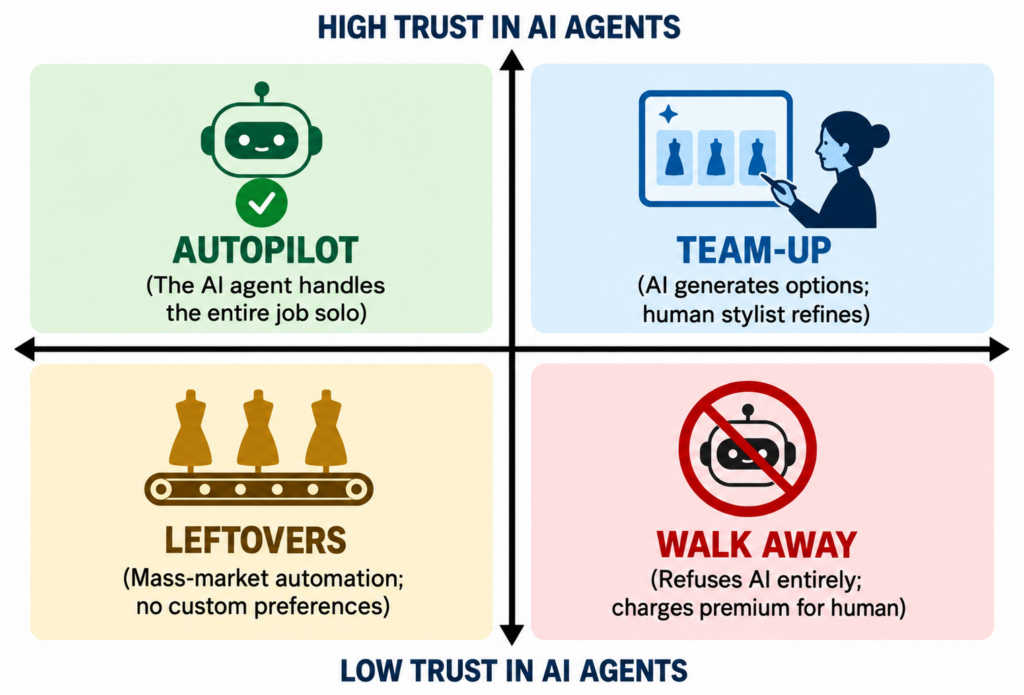
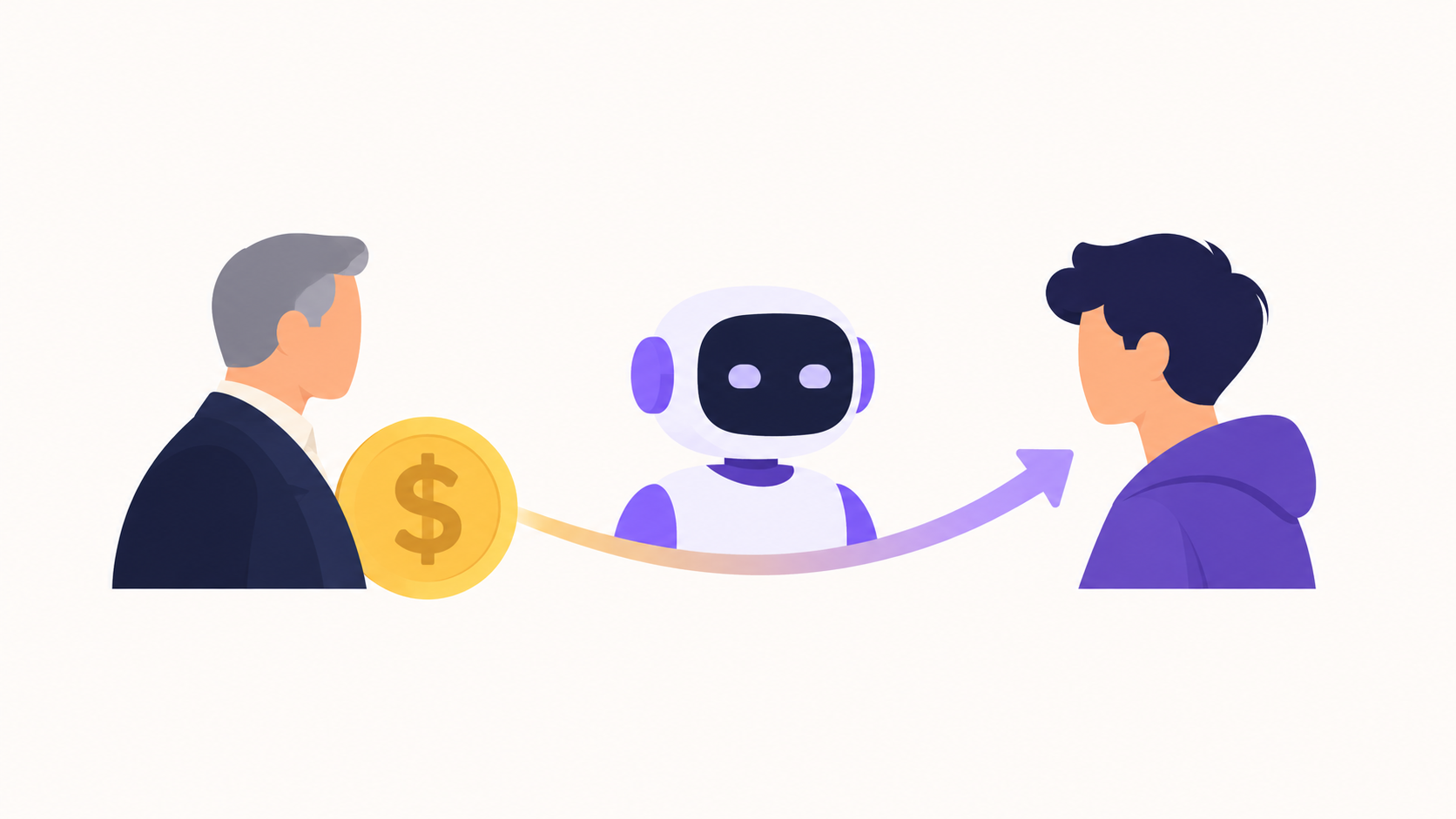
- The AI Autopilot: An AI agent handles the entire buying process on its own by understanding the user’s wardrobe history, evaluating options, negotiating pricing natively with the fashion house’s API, and executing the purchase. No screens required.
- The Hybrid Team-Up: A human stylist who uses deep predictive AI models to crunch data and map out variations, but personally picks up the phone to close the relationship-driven deal with the client.
- The Pure Walk Away: A craftsman or stylist who explicitly refuses to touch AI tools, charging a steep premium purely for un-automated human time.
Each model can be valuable.
The question is not whether AI should be used. The question is which type of experience customers are willing to pay for.
Why this changes product strategy
Without considering the generational shift, you would guess rich people naturally land on Walk Away or Team-Up, while everyone else defaults to Autopilot. That is only half right.
By 2036, premium customers will likely split into two distinct groups:
AI-Cautious wealthy (Gen X/Early Y) → Pays for Walk Away or Team-Up. These customers may pay extra for:
- Human expertise
- Manual review
- Transparency
- Validation checkpoints
For them, control itself becomes a luxury.
AI-Native wealthy (Late Gen Z/Alpha) → Demands Premium Autopilot. These customers may see automation very differently.
- They will not view full automation as a shortcut.
- They will view it as a premium convenience.
- Being forced to click through forms, navigate dashboards, or manually compare options may feel like poor design rather than reassurance.
The Key Shift
The wealthy customer of today and the wealthy customer of 2036 may have similar spending power but completely different expectations of AI.
That means product teams must define what “exclusive” means for both audiences.
Three Design Principles for the Next Decade
1. Design for Different Levels of Trust
DO:
- Build “Trust Sliders” and “Friction Dials”: Give wealthier, cautious users the ability to manually add extra check-in steps, code explanations, or step-by-step reasoning maps into an automated workflow.
- Design for Agent-to-Agent (A2A) Interaction: Ensure your product architecture allows a local AI agent acting as an assistant to scan, verify your ethical supply chain metrics, and buy your product directly without ever opening a visual screen.
- Allow Complete Automation Toggles: Let anyone turn off automation entirely on every plan, not just the expensive one.
- Ask for Preferences Directly: Ask new users straight up: “Want us to just handle this, or show you options first?” Do not guess their preferences based on their age.
DON’T:
- Assume Age Dictates Capability: Do not hide AI features under the guise of “simplifying for seniors.” Design the experience around building trust, remembering that older users hold the money to spend on you for decades.
- Assume Young Users Want Full Automation: Just because a user grew up around AI does not mean they want to hand over all control. Give them the same explicit choice to tweak decisions and step in.
2. Make AI Participation Transparent
DO:
- Show Your Work in Hybrid Systems: If you are selling an “AI plus a human expert” product, design a transparent interface that clearly shows what the machine calculated versus what the human expert changed.
- Provide Verifiable Proof for “Human-Only” Tiers: If you are charging more for a “No-AI, purely human-crafted” service, provide clear, checkable proof, real names, and real people to show exactly why the human touch is worth the extra cost.
DON’T:
- Hide AI to Fake High Quality: Hiding the presence of automated agents to make a service feel “fancier” will instantly push away an AI-native generation that values honesty over superficial polish. Hiding the AI kills the “I’m in control” feeling that serves as your actual selling point.
- Sell a Double Story: Do not sell the exact same feature as “no AI” to one customer and “AI-powered” to another just to trick people into paying a premium. Pick one clear story and stick to it.
3. Build Pricing for the Future Customer
DO:
- Differentiate Between Shared and Custom Engines: Tell people plainly whether they are using a shared, mass-market AI tool or an isolated model built exclusively for them.
- Plan Pricing for the Trust Handoff: Plan pricing around future customer expectations, not current ones. Invest in strong experiences at every tier.
DON’T:
- Treat Your Free Tier with Disrespect: Avoid designing mass-market or lower tiers as a broken, annoying downgrade. An AI-native generation without high spending power today still expects excellent efficiency, and they will remember how your system treated them when they have more capital later.
- Build for Today’s 45-Year-Old: Do not assume a wealthy persona from today will still fit the market in ten years. The affluent demographic of 2036 will belong to a different generation entirely.
The Bottom Line
The next decade isn’t just about wealth changing hands. It’s also about a fundamental shift in how people relate to AI. Today’s premium customer often wants oversight, validation, and human involvement. Tomorrow’s premium customer may expect intelligent systems to work on their behalf with minimal friction. Products built for the future will support both mindsets. They will offer control for those who want it, automation for those who trust it, and transparency for everyone.
Because the real challenge isn’t designing for one generation. It’s designing for the moment when wealth and trust cross paths.
Methodology Note: The scenarios and futures frameworks detailed in this piece are synthesized using the Oxford Scenario Planning Approach (TUNA conditions) to map contextual macroforces, intersecting Jim Dator’s Four Archetypes with modern human-AI workflow paradigms.
If you want to run futures thinking exercises, apply scenario planning frameworks, or leverage AI to run foresight workshops for your product teams, let’s chat. Reach out to me on LinkedIn.