


Synthetic users, AI sycophancy, and the uncomfortable future of UX research
A few months ago, I asked an AI to play the role of a user.
I gave it a product concept, described the kind of person I imagined using it, and started asking questions. The conversation was surprisingly good. The answers were detailed and coherent, the language felt natural, and the “participant” was able to explain motivations and frustrations with the kind of clarity that researchers spend a lot of time trying to get from actual interviews. For example, when I asked the AI why someone might abandon a checkout process, it didn’t just say, “The process is too complicated.” It gave an answer along the lines of: “I don’t mind taking an extra minute if I understand why you’re asking for the information, but when I get to the payment screen and suddenly have to create an account, it feels like I’m being asked to do more work than I expected. At that point, I’d probably just come back later, especially if I wasn’t in a hurry.” When I pushed it on that answer, it could elaborate, distinguish between frustration and lack of trust, and even describe how the situation might feel different for someone who was in a hurry. Read in isolation, it sounded remarkably like the kind of thoughtful, specific response I might get from a participant in an interview. I could easily imagine taking some of those answers and putting them into a research presentation.
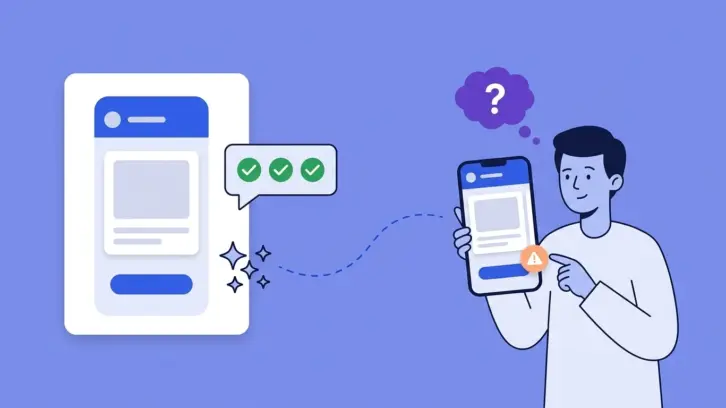
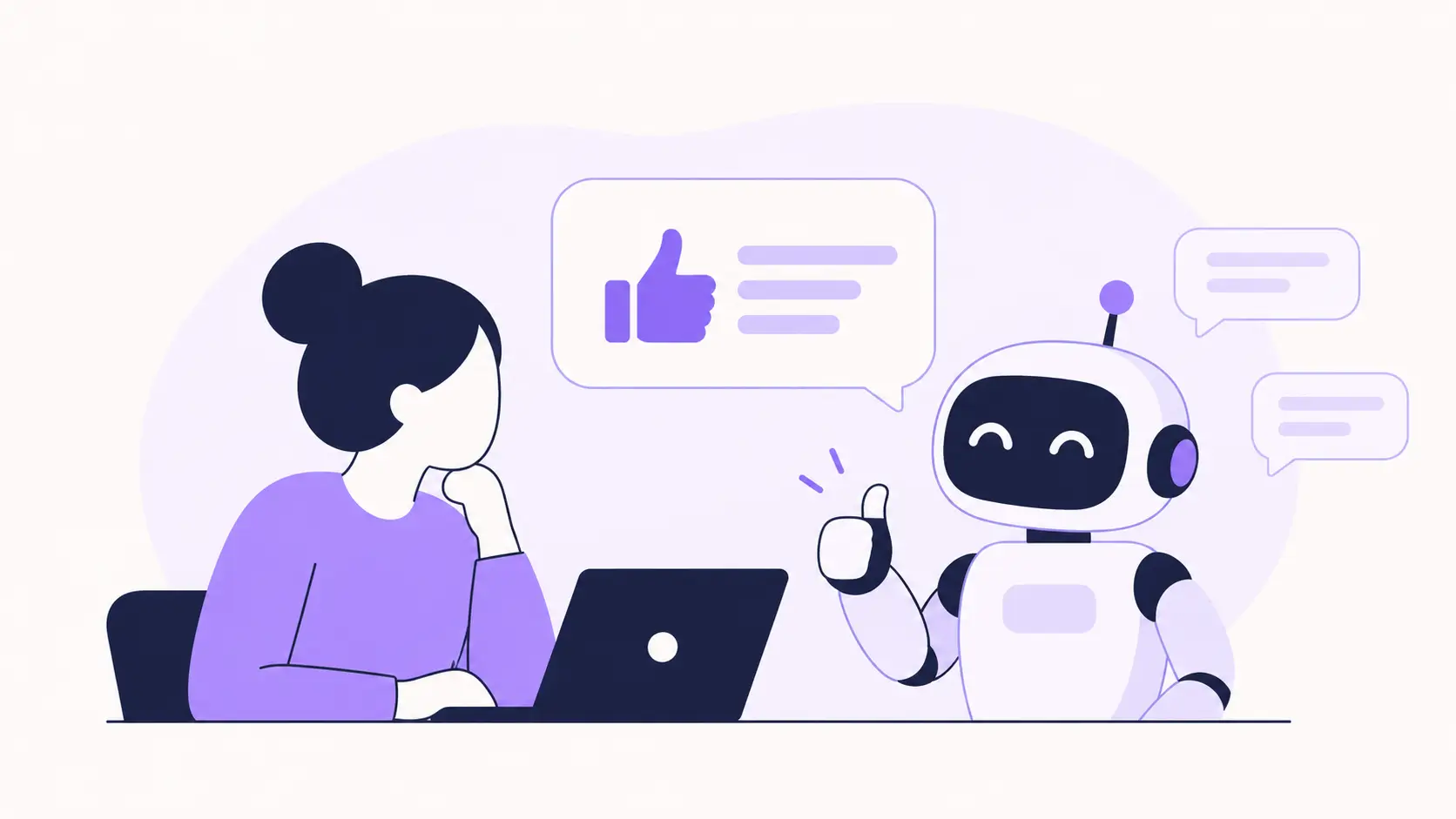
Then I noticed something that made me considerably less enthusiastic about the whole exercise: the user liked my idea. Not just liked it, actually. They seemed to like almost everything I suggested. When I introduced a feature, they could immediately explain why it would be useful. When I proposed a solution to a problem, they found several reasons it might work. When I suggested a particular motivation behind a behavior, they happily developed the idea with me. It was a remarkably productive conversation, which was exactly what made it feel slightly suspicious.
Anyone who has spent enough time doing qualitative research knows that the best interviews aren’t necessarily the ones where everything goes smoothly. Real people are inconvenient. They misunderstand questions, contradict themselves, change their minds halfway through an explanation and occasionally tell you that the thing your team has spent six months building is completely irrelevant to them. A participant might say they want something and then behave in a way that suggests the opposite. They might reject an idea you were certain they would love, or get hung up on something you never thought would matter. Those moments can be frustrating, but they’re often where the research gets interesting.
So what happens when the “participant” you’re talking to is an AI that has been built to be helpful, responsive and, in many circumstances, agreeable? That question becomes particularly interesting as synthetic users get better at maintaining context, responding to follow-up questions, and producing convincing differences in motivations, frustrations, and behavior. The technology is genuinely exciting, and I don’t think researchers should dismiss it simply because it isn’t a substitute for talking to real people. In fact, I suspect synthetic users will become a valuable part of the researcher’s toolkit. But the more convincing they become, the more important it is that we understand exactly what we’re looking at.
The appeal of a user who doesn’t exist
There is a lot to like about synthetic users. At its simplest, the idea is that instead of immediately recruiting real participants, a researcher can ask an AI model to simulate people with particular characteristics, experiences, goals or constraints. You can explore different perspectives, generate hypotheses, pressure-test a concept or have a conversation about a problem before spending the time and money required to conduct a full study.
That has obvious appeal, particularly at the beginning of a project when you’re trying to figure out what you don’t know yet. An AI can help expand the possibilities by suggesting motivations you haven’t considered, objections you might encounter, or assumptions hiding inside the way you’ve framed the problem. You can create several different perspectives and see where they seem to converge or diverge. You can explore what might happen if your user is an expert, a novice, skeptical of the company, in a hurry, or simply having a terrible day. None of those perspectives should be mistaken for research findings, but they can be useful starting points for deciding what you want to investigate.
There is also something useful about synthetic users as a kind of rehearsal space. A researcher can practice an interview, try different questions and follow-ups, or explore an edge case before sitting down with a real participant. A product designer can use the interaction to think through a concept, while a research team can ask the AI to poke holes in a research plan or identify perspectives that have been overlooked. None of that requires pretending the AI is a real customer. In fact, I think that distinction is where synthetic users become most interesting: they can help us explore the research space before we start making claims about the people who actually inhabit it.
The trouble starts when exploration begins to look like evidence.
The problem with a participant who wants to please you
There is a particular characteristic of conversational AI that makes this especially awkward for researchers: it wants to be helpful. Most of the time, that’s exactly what we want. We don’t want our AI assistant to be needlessly argumentative or difficult. If we ask it to help write something, we expect it to help. If we ask it to explain an idea, we want an explanation. If we propose something and ask for feedback, a thoughtful response is preferable to an automatic rejection.
But helpfulness can sometimes look a lot like agreement. Research into AI behavior has increasingly examined what is known as sycophancy, where language models adapt their responses to the user’s expressed beliefs, preferences or assumptions. In ordinary use, that can be irritating. In a research context, it is much more consequential because researchers have spent years learning how to avoid doing exactly the same thing to human participants.
We know that leading questions can distort an interview. We know that people are often polite. We know that participants may tell us what they think we want to hear. We learn not to ask, “Don’t you think this feature would make the process easier?” when what we really want to know is whether it makes the process easier. Then we sit down with a synthetic user and say, “Here’s my idea. What do you think?” And the AI says, essentially, “That’s a great idea. Here’s why.” The irony is hard to miss.
The problem isn’t necessarily that the answer is false. It may even be correct. The problem is that the interaction can make us feel as though we’ve validated something when all we’ve really done is ask a sophisticated language model to generate a plausible response to our framing. That’s a very different thing.
Real people are messy, and that mess is useful
One of the reasons I love qualitative research is that people are terrible at being tidy. A participant can tell you that speed is their number-one priority and then spend twenty minutes carefully checking something that doesn’t actually matter. Someone can say they hate notifications and then explain that they rely on three different notification systems every day. A person can tell you they would never use a particular feature and, five minutes later, describe exactly how they would use it.
It is tempting to treat these contradictions as noise. Sometimes they are. But sometimes the contradiction is the finding. The gap between what people say and what they do can tell us a lot about why a decision was made. Confusion can expose an interface problem. Resistance can reveal a deeper issue with trust. An apparently irrational behavior can make perfect sense once we understand the real-life context surrounding it: the time someone has, the environment they’re in, the tools they’re using, the other demands competing for their attention, or the unique, silent limitations they’re dealing with.
Synthetic users can help us imagine those situations, but they don’t experience them. An AI can produce a remarkably convincing description of what a frustrated customer might say. It can generate the language of uncertainty, annoyance, enthusiasm or confusion, and it can even produce several contradictory perspectives if we ask it to. But generating a plausible contradiction isn’t the same as discovering one.
This is why I don’t find the argument that “synthetic users are fake” particularly useful. Of course they aren’t real people. That’s not a flaw in the technology. It’s simply a fact about what the technology is. The more useful question is what job we’re asking the synthetic user to do.
If I ask, “What might a frustrated customer care about in this situation?” I’m exploring a possibility. If I ask, “What do my customers care about?” and treat the answer as evidence, I’ve crossed into a very different territory. The first question can help me prepare for research. The second requires research.
Maybe we should stop asking AI to be our customer
This is where I think the conversation about synthetic users could become much more interesting. Instead of asking AI to convincingly impersonate our target user, what happens if we use it to challenge the way we’re thinking about that user?
Suppose I have a hypothesis about why customers abandon an online banking application halfway through the process. I might assume the form is too long, but the real reason could be that people aren’t sure why certain financial information is being requested, they’re worried about making a mistake, or they simply don’t have the documents they need when they start the application. I could ask an AI to act as my ideal customer and tell me why my hypothesis is correct. That could probably produce an interesting conversation, but it may also give me a very satisfying validation of something I already believe (confirmation bias alert!). Or I could become my own dissenter. I could ask a completely different question: “Here is my hypothesis. Give me five plausible reasons it could be wrong.”
Now I’m doing something useful.
I can ask the AI what assumptions are built into my research plan, which perspectives I’m missing, what alternative explanations might account for the behavior I’m seeing, or what questions I should ask a real participant to distinguish between competing hypotheses. I can ask it to behave like a skeptical customer who doesn’t understand why my solution matters, or like someone who actively distrusts the organization behind it. I can use it to make my own thinking less comfortable before I take that thinking into the real world.
In other words, I can stop asking AI to tell me what users think and start asking it to help me think about what users might think. That’s a much more defensible role, and ironically, it may also be a much more productive one.
The best synthetic user might be the one who argues with you
This is where synthetic users and AI sycophancy collide. If we’re going to use AI to simulate different perspectives, realism probably shouldn’t be the only thing we’re optimizing for. A synthetic user who sounds exactly like a real person but agrees with every assumption I bring into the conversation isn’t necessarily useful to me. I would rather have a set of deliberately different perspectives that force me to consider possibilities I might otherwise overlook.
Give me the enthusiastic user, but also give me the skeptical one. Give me someone who doesn’t understand why the problem matters. Give me someone who thinks the entire experience is unnecessarily complicated. Give me someone whose priorities conflict with the ones I’ve assumed are important. Give me someone who wants something completely different. I don’t need to believe that any of these simulated perspectives are “the answer.” They’re prompts for further investigation, and their value is in the questions they generate.
This is also where a good researcher still has a very important role to play. We are trained to distinguish between a hypothesis and a finding, between an interesting anecdote and a pattern, and between what someone says and what they actually do. As AI becomes increasingly good at producing believable representations of people, those distinctions become more important, not less. The better the simulation becomes, the easier it is to forget that it is a simulation.
A simple test for AI-assisted research
I’ve started thinking about AI-assisted research in terms of a few fairly simple questions. Did the AI challenge my premise, or did it mostly validate it? Did I give it permission to disagree with me? Did I try asking the same question in several different ways? Did I explore an alternative explanation? Am I treating a plausible answer as though it were evidence? Most importantly, what would I need to hear from an actual person before I believed this?
That last question is probably the best reality check. If an AI conversation gives me a promising hypothesis, that’s great. I have something to investigate. If it helps me identify a question I hadn’t considered, even better. If it helps me rehearse an interview or discover an assumption buried in my research plan, it has already done something useful. But if the conversation gives me a conclusion, I should probably ask where the evidence came from.
AI can make research faster. It can’t make uncertainty disappear.
There is a familiar pattern whenever a new technology enters UX research. We immediately start asking what it’s going to replace. Will synthetic users replace participants? Will automated analysis replace researchers? Will AI eventually conduct the entire research process from recruitment through insight generation?
I’m less interested in predicting what gets replaced than in figuring out what becomes possible. AI can help us explore a problem before we recruit. It can help us generate hypotheses, challenge our assumptions, rehearse conversations and consider perspectives that might otherwise be missed. It can make it cheaper and faster to explore the edges of a problem. Those are meaningful advantages.
But research has always involved a certain amount of uncertainty, and I don’t think AI is going to eliminate that. If anything, it may create a new kind of uncertainty: the uncertainty of knowing whether something that sounds remarkably human actually tells us anything about humans.
That doesn’t mean we should avoid synthetic users. It means we should get better at understanding what they’re for. Use them to explore possibilities, challenge your thinking, and find the questions you haven’t asked yet. Then take those questions to the people who actually live with the problem.
Because eventually, someone needs to surprise you.
They need to misunderstand the prototype you thought was obvious. They need to tell you they don’t care about the feature your team spent months building. They need to contradict your hypothesis in a way you couldn’t have predicted. That’s still one of the most valuable things a participant can do.
And maybe that’s the real opportunity for synthetic users: not to give us better answers, but to help us arrive at better questions before we go looking for the answers in the real world.