


Product teams today face a difficult choice about how they learn from users. One camp runs structured research projects led by specialists. Another builds research into the product team’s weekly rhythm. Both want the same outcome: to build products people actually want. They just go about it in very different ways.
Historical startup data shows that 42% to 43% of new ventures fail because they build products or features the market does not want. Choosing the right way to stay connected to users is not a process detail. It is a survival decision.
This article breaks down both approaches across speed, depth, cost, and team structure. The short version is that this is rarely a case of one winning outright. The better question is which approach fits the decision in front of you, and most mature teams end up using both.
Key Takeaways
- Around 42% to 43% of startups fail because they build products customers do not want, making user research critical to product success.
- Traditional user research is a structured method used by product, UX, and business teams to understand customer needs, explore new markets, and answer high-stakes strategic questions before investing in solutions.
- Continuous discovery is an approach in which product teams regularly talk to users and test ideas, enabling them to make faster product decisions based on real feedback.
- Traditional research relies on dedicated researchers and in-depth methods such as interviews, diary studies, and ethnographic research, which 86% of UX professionals use.
- The most effective product teams combine both approaches, using traditional research to set strategy and continuous discovery to guide day-to-day product decisions.
What Is Traditional User Research?
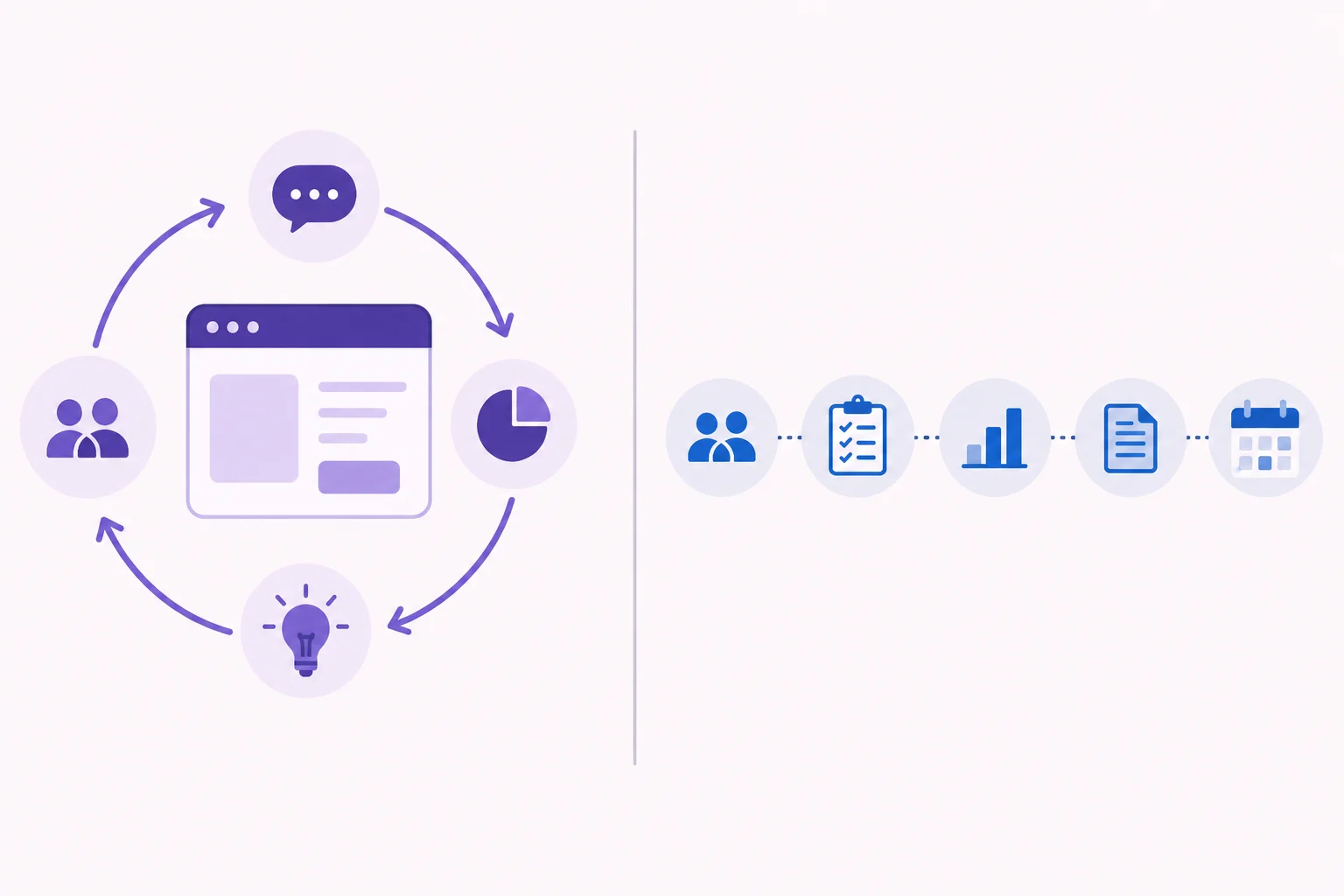
Traditional user research is a structured, project-based model built to answer specific, high-level business questions. It follows a linear lifecycle: a project brief, participant recruitment, data collection, thematic synthesis, and a final report. A dedicated researcher usually owns the work from start to finish.
This model is built for depth. It is the right tool when a team needs to understand a new market, define a complex product architecture, or frame a problem space before any solution exists. Classic qualitative techniques such as ethnography, diary studies, and semi-structured interviews are used by 86% of UX practitioners to build this kind of foundational understanding.
The trade-off is time. A dedicated discovery phase can take from two weeks to several months. That depth is valuable for product strategy, but its not suitable for a product development cycle.
What Is Continuous Discovery?
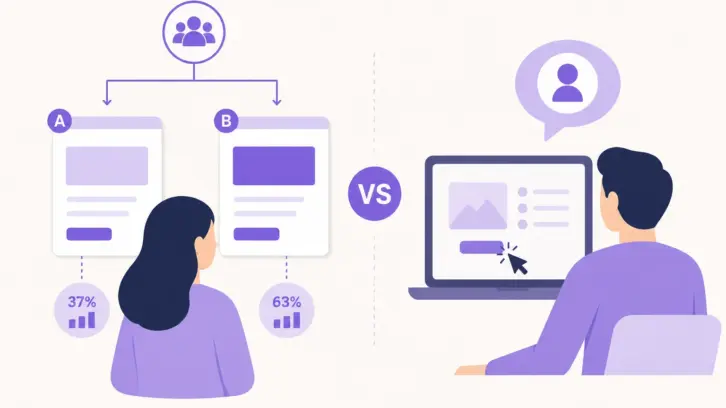
Continuous discovery integrates customer validation into the product team’s weekly rhythm. Popularized by Teresa Torres, the approach holds that the team building the product should maintain at least one weekly touchpoint with a customer to guide its decisions. Large, infrequent research projects are replaced by a steady flow of multiple short usability testing at scale, generating real-time insights.
This work is usually led by a product trio, comprising a product manager, a designer, and an engineer who share ownership of the risks. Adoption is now mainstream, with 62.8% of product teams reporting an active trio structure.
The strength here is speed and shared ownership. The team learns and acts in the same cycle, which keeps decisions close to real user behavior. The trade-off is that it favors current, active users and can miss the bigger strategic picture if used alone.
Continuous Discovery vs. Traditional User Research: Understanding the Key Differences
While both approaches help teams learn from users and make better product decisions, they differ significantly in how often research happens, who owns the work, and the types of questions they are designed to answer. The table below highlights the most important distinctions:
| Dimension | Traditional User Research | Continuous Discovery |
| Cadence | Project-based, weeks to months | Weekly, ongoing |
| Owner | Dedicated researcher | Product trio (PM, designer, engineer) |
| Best for | Foundational, strategic questions | Near-term feature and validation decisions |
| Depth | High, rigorous | Lighter, faster |
| Speed | Slower, thorough | Fast, iterative |
| Main risk | Can lag behind fast product cycles | Can over-index on vocal current users |
The fundamental difference is straightforward: traditional user research goes deep to answer large, strategic questions, while continuous discovery focuses on answering smaller questions quickly and keeping teams connected to users on an ongoing basis. Rather than replacing one another, the two approaches work best together, with each serving a distinct role in the product development process.
When Traditional User Research Works Best
Traditional research earns its time cost when the stakes are high and the question is foundational. Use it when:
- You are entering a new market or serving a user group you do not yet understand
- You need to define a complex product architecture before design begins
- You are studying vulnerable populations or sensitive topics that demand methodological care
- The decision is large enough that a wrong turn would be expensive to reverse
This is also where investment pays off most. The Nielsen Norman Group found that testing a design with just five representative users uncovers roughly 85% of core usability problems, preventing costly fixes later.
For studies like these, moderated research gives a skilled researcher room to probe for the reasoning behind user behavior, which is exactly what foundational questions require.
When Continuous Discovery Works Best
Continuous discovery shines when the team is moving fast, and the questions are smaller and more frequent. Use it when:
- You are iterating on features within short sprint cycles
- You need to validate a near-term design decision before building it
- You want the whole product trio to share a direct connection to users
- You are testing assumptions continuously rather than in one big batch
There is an important caution. When teams chase the weekly interview as a target, they can make sweeping decisions from a single, unrepresentative conversation. Patterns from interviewing one user per week typically take four to five weeks to emerge, so making fast decisions based on single sessions is risky. Pairing weekly touchpoints with unmoderated remote testing adds the behavioral data that single interviews miss.
Why the Best Teams Use Both
Continuous discovery and traditional user research are not competing approaches. Instead, they work best together. Traditional research helps teams understand users, markets, and complex problems at a strategic level. Continuous discovery helps teams validate ideas, gather feedback, and make product decisions quickly.
The strongest teams run a dual-track model. They use project-based research to set strategic direction, then use continuous discovery to execute against it week to week. To keep that balance reliable, many teams establish a research operations function and a shared repository so insights from both tracks stay connected. The research shows that teams supported by a dedicated research operations specialist report a 22% point increase in managing research demand.
A platform like UXArmy supports both tracks in one place. You can run deep, moderated studies for foundational questions and fast, unmoderated tests for weekly validation, with a participant panel across Asia-Pacific and support for local languages, so you reach the right users in either track.
Conclusion
Continuous discovery, rather than traditional user research, is the wrong way to frame the choice. Traditional research answers the big strategic questions with depth. Continuous discovery answers smaller, more frequent questions quickly. Used together, they cover both ends of the spectrum.
To decide for your own team, look at the question in front of you. If it is foundational and high-stakes, invest in structured research. If it is a fast, near-term decision, lean on continuous discovery. Then build the operational backbone that lets both run side by side, and your product decisions will stay grounded in real users at every speed.
Frequently Asked Questions
What is the main difference between continuous discovery and traditional user research?
Traditional research runs as time-bound projects led by a specialist to answer strategic questions. Continuous discovery is weekly, ongoing research led by the product team to guide near-term decisions.
Is continuous discovery replacing traditional user research?
No. Continuous discovery handles fast, near-term validation, while traditional research handles deep, foundational questions. Most mature teams use both in a dual-track model rather than choosing one over the other.
Who runs continuous discovery?
A product trio usually runs it, comprising a product manager, a designer, and an engineer who share ownership of product risks. They conduct interviews and prioritize decisions together each week.
What is the biggest risk of continuous discovery?
Relying on too few conversations. Decisions based on a single weekly interview can be misleading, since reliable patterns usually take four to five weeks of interviews to emerge clearly.
When should a team choose traditional research over continuous discovery?
Choose traditional research for foundational, high-stakes questions, such as entering a new market, defining complex architecture, or studying sensitive populations that require methodological rigor.