



You just wrapped a round of user interviews on your new onboarding flow, and your PM wants numbers before it ships. That’s the exact moment when formative vs summative usability testing stops being a vocabulary question and becomes a real decision. One method tells you what to fix, and the other tells you whether you’re done fixing it.
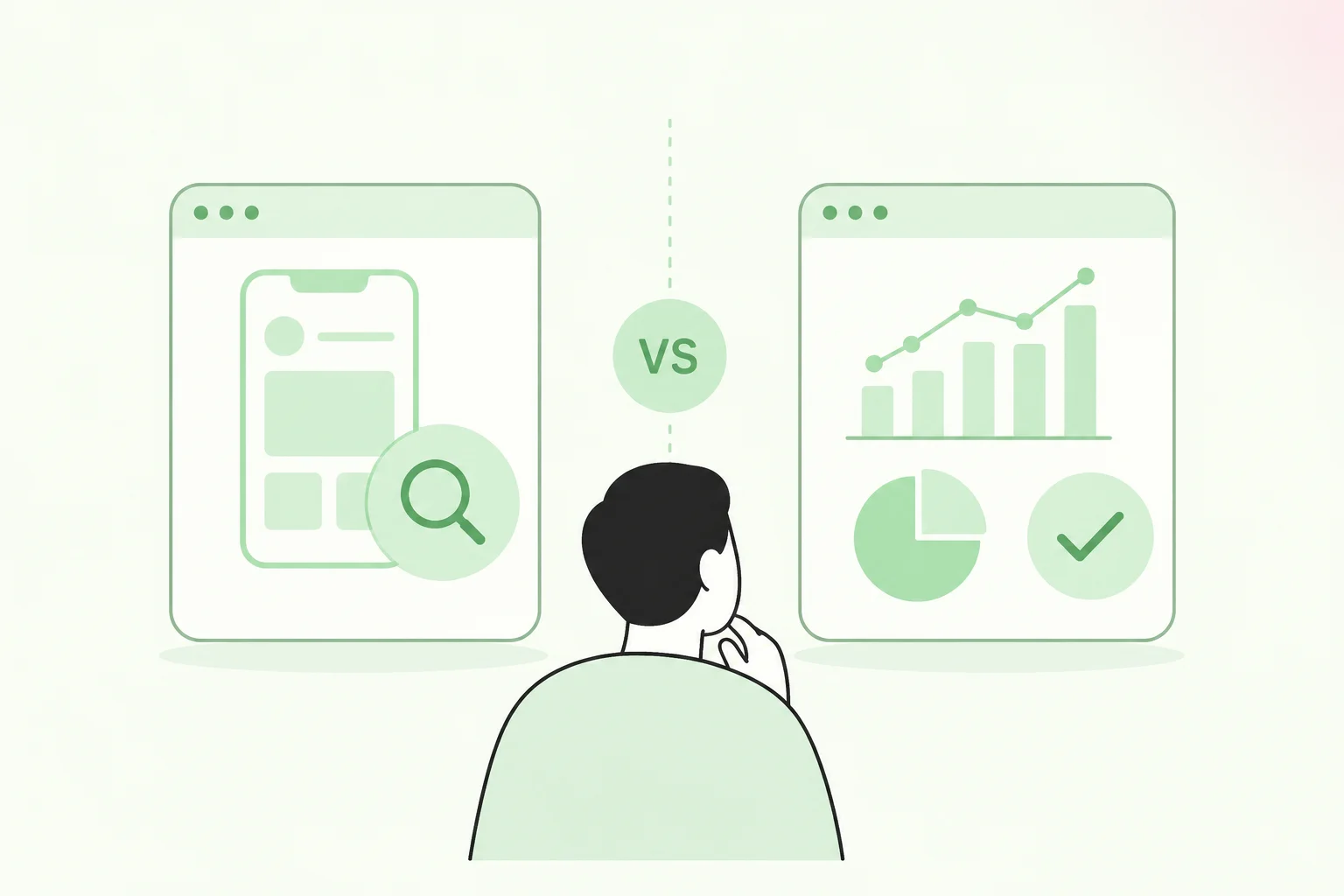
Formative vs summative usability testing comes down to timing and purpose. Formative usability testing runs as early as right from the wireframe stage, to find and fix usability issues while changes are still cheap. Summative usability testing is conducted near the end of development to assess whether the finished product meets predefined success criteria.
Key Takeaways
- Formative usability testing runs early and often throughout the design phase, using small samples of 5 to 8 users to learn why something isn’t working, not just whether it works.
- Summative usability testing occurs once a product is close to final, usually with 15 to 20 users, and measures performance against a fixed benchmark, such as task completion rate or System Usability Scale score.
- Trust Bank in Singapore pairs both test types inside the same sprint cycle and credits that pairing with five times faster design decisions.
- ISO 9241-11 defines usability as effectiveness, efficiency, and satisfaction, which is exactly what summative usability testing is built to measure.
- Choosing between formative and summative usability testing depends on your product’s stage, not on which method sounds more rigorous.
What Is Formative Usability Testing?
Formative usability testing is a round of testing you run on an unfinished design to find out why users struggle with it. Nielsen Norman Group usually runs these sessions with five to eight users. The goal at this stage is depth of insight per problem, not statistical confidence.
Picture a fintech team three weeks into redesigning its loan application flow. They hand a Figma prototype to six target users and ask them to think aloud as they apply for a loan. Two of the six abandon the flow at the income verification step, and neither says a word about being confused.
Most teams don’t stop at one round. A typical formative cycle runs two or three rounds across the design. The first round uses a low-fidelity wireframe to test flow and labeling. The second uses a working prototype to test interaction details, and some teams add a third round after a major redesign.
Formative usability testing is one part of the broader usability testing toolkit. It’s usually run using one or more of these methods:
- Think-aloud protocol: users narrate their thoughts aloud while attempting a task, either in a moderated or unmoderated setting. This surfaces hesitation the moment it happens, not in a survey answer written after the fact.
- Cognitive walkthrough: a researcher steps through a task the way a first-time user would, before real users ever see the design. It catches obvious problems early and cheaply, though it can’t replace watching an actual user struggle.
- Moderated sessions on wireframes: a researcher guides five to eight users through a low-fidelity prototype and asks follow-up questions in real time. This works best when the design is too rough for people to use unassisted.
- First click testing measures whether users tap the right first step toward a task on a wireframe or early prototype. It’s fast and cheap enough to repeat after every round of changes, and a wrong first click here is worth fixing before the rest of the flow gets built out.
- Preference testing shows users two early design directions side by side and asks which one they’d choose and why. It’s most useful when two directions have both survived initial rounds and the team needs to pick one before building further.
Jakob Nielsen’s original research for Nielsen Norman Group found that testing five users in a single round surfaces about 85% of a design’s usability problems (Nielsen, 2000). The finding is decades old, but it’s still the standard justification for small-sample formative testing today.
What Is Summative Usability Testing?
Summative usability testing measures whether a finished or near-finished product meets a defined usability bar. ISO 9241-11 frames that bar as three things: effectiveness, efficiency, and satisfaction, each one scored with numbers instead of impressions.
Picture that same fintech team eight weeks later, with a fully built loan flow ready to launch. They’d test it with 18 users and calculate a System Usability Scale score to check against last quarter’s release. A score in the mid-70s would put them meaningfully above the widely cited industry average of 68.
Most teams don’t run summative testing just once, either. A pre-launch round confirms the product clears its bar before release. A second round, three to six months later, checks whether real-world use matches the lab result. Usage patterns often shift once real users take over from test participants.
Common methods for summative usability testing include:
- Task-based quantitative testing measures completion rate, time on task, and error rate as users work through the exact tasks the product needs to support. This is the most direct evidence of whether the product works, since it measures behavior instead of opinion.
- System Usability Scale (SUS): a 10-item survey that yields a single usability score on a 100-point scale. The industry average is 68, so a rising score across releases is one of the clearest ways to show that a redesign is working.
- Benchmark testing compares those scores against a fixed baseline, either the team’s own previous release or a named competitor’s product, using the same tasks both times. A single score means little on its own, a benchmark is what turns it into evidence.
Sample sizes climb here because the output is a number, and numbers need enough participants to mean something. ISO 9241-11:2018 defines the criteria against which summative usability testing is assessed.
How Do You Choose Between Formative and Summative Usability Testing?
The choice comes down to where your product sits in development, not which method sounds more rigorous. UXArmy customers who run both formative and summative usability testing usually treat the switch as a stage rather than a strategy. They move from one method to the other as a feature matures.
| Factor | Formative Usability Testing | Summative Usability Testing |
| Primary question | Why isn’t this working? | Does this meet the bar? |
| Typical stage | Wireframes through mid-fidelity prototypes | Near-final or launched product |
| Sample size | 5 to 8 users | 15 to 40 users |
| Data type | Qualitative: observations, quotes | Quantitative: rates, scores |
| Common methods | Think-aloud, cognitive walkthrough, first click and preference testing | Task-based testing, SUS scoring, benchmark testing |
| Typical output | A list of usability issues to fix | A pass/fail decision or benchmark score |
Skipping straight to summative testing is the most common mistake teams make under deadline pressure. A team that tests a finished feature for the first time with 20 users gets a pass or fail number. It gets no explanation of why the feature failed.
Running even one small formative round first gives that summative test something to build on. Three or four users on a rough version beat starting from a blank page.
How UXArmy Supports Both Formative and Summative Usability Testing
Trust Bank, the Singapore digital bank backed by Standard Chartered and FairPrice Group, tests loan, card, and rewards features on tight sprint timelines. Its team runs unmoderated formative usability testing on Figma prototypes through UXArmy nearly every sprint. Before each release, it benchmarks the live app against competitors’ apps separately. Over 18 months and 20-plus features, that sequence helped Trust Bank’s design decisions move five times faster.
Conclusion
The fastest way to waste a usability test is by running the wrong type for your product’s stage. Formative testing tells you what to fix while your design can still change. Summative testing tells you whether what you built actually works.
The real question isn’t which method is better. It’s whether your team runs both, or skips straight to validation and hopes nothing important got missed. Before your next launch gate, a moderated research session on whatever’s still unfinished might be the more honest place to start. Are you testing to find problems, or just testing to confirm you already found them all?
See Formative and Summative Testing Work Together
If you’re not sure whether your next test should be formative or summative, the format matters less than actually running one well. Start testing with UXArmy and set up both types inside the same platform, on the same dataset your team already trusts. No credit card is required to get your first test live.
FAQs on Formative vs Summative Usability Testing
What is the difference between formative and summative usability testing?
Formative usability testing happens early in design, using five to eight users to find and fix problems. Summative usability testing happens near launch, using fifteen to twenty users to check the finished product against a benchmark.
What is a formative usability test?
A formative usability test is a small, early-stage session run on a wireframe or prototype. Researchers observe users as they attempt a task and ask why they hesitate, not just whether they succeed. UXArmy customers often run these with five to eight participants per round.
What is summative usability testing?
Summative usability testing evaluates a finished or near-finished product against predefined success criteria, such as task completion rate and System Usability Scale score. Teams usually run it with 15 to 20 participants right before launch to benchmark against a previous release. That benchmark is only useful if it was set correctly to begin with.
What is the 5-user rule in usability testing?
The five-user rule comes from Nielsen Norman Group’s research. It found that testing five users in a single round surfaces about 85% of a design’s usability problems. It applies to formative testing, not summative testing, where larger samples are needed for comparing usability metrics reliably.
What are some formative usability testing methods?
Common formative usability testing methods include think-aloud protocols, cognitive walkthroughs, and moderated sessions on a wireframe or prototype. A team testing a loan application flow might run a think-aloud session with six users. Half of them can still stumble on the same unlabeled field.