



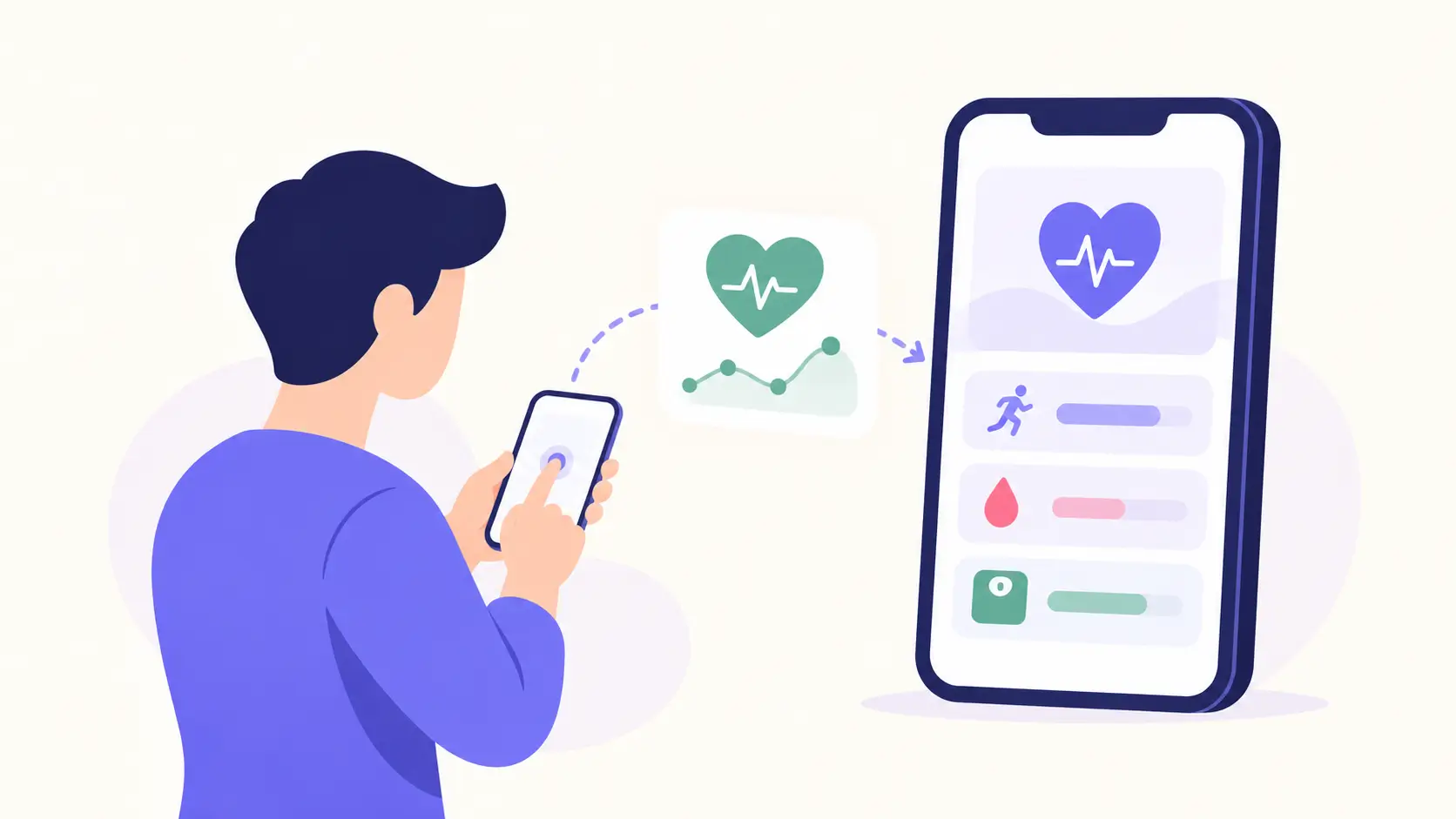
A daughter unlocks her father’s phone to renew his diabetes prescription because he has never trusted himself with the app. A husband reads a one-time password down the phone to his wife, who is standing at a hospital reception desk. A young caregiver fills in a GP’s online form on behalf of a grandmother who has never touched a touchscreen.
None of these people are the “user” most health apps were designed for. And yet, if you look closely at how digital health tasks actually get done, moments like these aren’t the exception- they’re routine. A task starts with one person and finishes in someone else’s hands. I call this concept a “handoff”, and it is one of the most under-researched, under-designed spaces in “digital health”.
The Single-User Assumption in Health App UX
Most health apps are still built around a quiet assumption: one person, one device, one account, one continuous session. Onboarding flows ask for *your* name, *your* date of birth, *your* consent. Notifications are written as if only one set of eyes will ever read them. Even our research methods reinforce this – we recruit “the user,” interview “the user,” and design personas around a single, stable individual moving through a single, stable journey.
Real life rarely works that way, especially in health. People delegate digital tasks to children, spouses, neighbours, carers and community health workers – sometimes for a single login, sometimes for the rest of a chronic condition. HCI researchers have documented this for years under names like “proxy use” and “surrogate use”: people acting on a system on behalf of someone else, often filling gaps left by literacy, language, disability, trust or simple unfamiliarity with a device. The internet-studies scholar Maria Bakardjieva gave us a useful term for the person who does the delegating work – the warm expert, the friend, relative or neighbour who translates a cold, unfamiliar system into something usable for someone they care about. Every family has at least one.
Distributed cognition adds another piece: some tasks were never meant to live inside a single head, or a single account. Reading blood pressure numbers, remembering when a repeat prescription is due, deciding whether a symptom is serious enough to act on these are cognitive tasks that, in practice, get spread across a phone, a notebook by the kettle, a WhatsApp group of siblings, and whoever happens to have a signal that day. When a product assumes the task lives in one place, it makes that distributed work invisible, and invisible work is work that gets no support- a repeat prescription lapses because everyone assumed someone else had reordered it; a symptom goes unmentioned to a GP because the person who noticed it wasn’t the one with the login to message the surgery.
What Anthropology Teaches Us About Caregiver UX
This is where I’d push the HCI account further, because it can make delegation sound like a fixed role: “the patient” and “the carer”, when in reality, care moves.
In my own doctoral fieldwork with stroke survivors and family caregivers in New Delhi, over seven family cases (40 participants- including children) and more than seven months in the field- doing in-depth ethnographic work, one finding kept surfacing across almost every household: caregiving was never anchored to one fixed person. It travelled across immediate family, extended family, friends, neighbours and community networks, shifting with the week, the season, and who happened to be free, financially able, or emotionally willing at that moment. In practice, that could look like one relative managing medication in the morning, another handling hospital paperwork, and a neighbour stepping in during the afternoon so the primary caregiver could work, the specific people changing from household to household and month to month. The values that organised this – Dharma (duty), good karma, Seva (selfless service), and family honour motivated care could also intensify the burden on whoever ended up holding it.
That is, in essence, exactly what happens with a shared health app, just at a smaller scale and a faster tempo. The “who does this task today” question in a family is a live, negotiated, culturally shaped decision, not a fixed field in a database. Anthropology’s contribution to this conversation is a reminder that a handoff is never neutral. It sits inside kinship obligations, gender roles (the orthodox assumption that caregiving responsibilities fall on women in the family while men are expected to provide financial support), and unspoken rules about who is allowed to know what about whom. A daughter reading her father’s test results is not the same act, socially or emotionally, as a stranger doing it, even if the digital interface treats both identically.
Sociologists of work have another term worth borrowing here: Articulation work – the invisible coordinating labour that makes a handoff go smoothly (or fall apart) without ever appearing in the “official” task itself: working out who has the password, deciding what to tell the other person and what to leave out, timing a call around a shift pattern. UX research rarely goes looking for this work, because it happens in the gaps between the screens we usually test.
Behavioural Science, Trust and Cognitive Load in Health Apps
Behavioural science explains why these handoffs are so fragile. Trust between the two people in a handoff is rarely symmetrical: the person handing over the task often has more health literacy or digital confidence than the person receiving it, and vice versa for the app itself. Decision fatigue compounds this: a caregiver already managing medication, appointments and finances has less cognitive bandwidth to also become the household’s app expert. And because most systems only ever ask “is this really you?”, they have no good way to ask, “who else needs to know, and how much?” so families improvise around the product with shared logins, screenshots and dictated OTPs, all of which quietly increase the chance of a missed dose, a lapsed appointment or a data-sharing decision nobody actually agreed to.
How to Research and Design Health App Handoffs
If handoffs are this common, they deserve their own place in a research plan, not a footnote in someone else’s. A few things I’d encourage UX teams to try:
1. Interview the pair, not just the primary user: dyadic or family interviews surface the negotiation- who decided the other person would help, and what changed when they did.
2. Go where the handoff happens, and watch yourself watching it (draw on ethnography, observation and reflexivity): a hospital admission, a discharge conversation, or an ordinary afternoon at home shows negotiations that interviews reconstruct after the fact, but keep field notes on how your own presence in the room is shaping what people do and say.
3. Map “who does what, and when” over time: not just a single journey. Roles shift with a diagnosis, a bad week, or someone moving house; a static persona will miss this.
4. Ask about the workaround, not just the task: shared passwords, screenshots and read-aloud OTPs are usually a sign the product hasn’t recognised that a second person exists, and they’re where the real risk hides.
5. Design explicit, dignified handoff points: a “helping someone today” mode, clear delegated access, and language that doesn’t assume the reader is the only person who could plausibly be reading it.
6. Treat support as phased, not one-off: what a family needs when a condition is first diagnosed is different from what they need six months in; onboarding that only happens once will only ever serve the first version of that need.
7. Bring the person being helped into the room early: Co-design with both parties, not just the one who is easiest to recruit, changes what “usable” ends up meaning.
Why Health App Users Are Often Plural
None of this is a call to abandon single-user thinking everywhere; plenty of digital tasks really do sit with one person, start to finish. But in health, where the stakes of a missed step are highest, and the people involved are often least equipped to challenge a badly designed interface, treating “the user” as necessarily singular quietly excludes the very people doing the most work to keep care going. HCI gives us language for what’s happening; anthropology reminds us it’s shaped by relationships, culture and obligation, not just interface design; behavioural science explains why it’s so easy to get wrong. Put together, they suggest a fairly simple discipline for UX teams: before you ship a health flow, ask who else might be sitting in that chair and design as if you already know they will be.
Dr Madhur Mrinal is a UX researcher with a PhD in Health Sciences from Bangor University, UK, where his doctoral fieldwork examined family caregiving after stroke in New Delhi, India. His background spans anthropology, public health and behavioural science, and he currently volunteers as a UX Researcher with Think Round, Inc working on understanding the experiences of users interacting with virtual space design.
People Often Ask
Who uses health apps besides patients?
Health apps may also be used by family members, caregivers, spouses, children, community health workers and other proxy users who help someone manage digital health tasks.
What is proxy use in healthcare UX?
Proxy use occurs when one person interacts with a digital health system on behalf of another person, such as a caregiver managing appointments or prescriptions for a patient.
What is a handoff in health app UX?
A handoff occurs when a digital health task moves from one person to another, such as a patient asking a family member to complete a form, manage medication information or communicate with a healthcare provider.
How can UX teams design better health apps for caregivers?
UX teams can research caregiver and patient pairs, map changing roles over time, support delegated access, study workarounds and create explicit mechanisms for safely handing tasks between people.