


You’re staring at a testing script five minutes before a session starts, and every question on it sounds like the last study you ran. The right user testing questions change shape depending on the stage, whether you’re validating a raw idea, testing a Figma prototype, or chasing a bug before launch. New to research planning? Start with this guide for product managers, then come back for stage-specific questions.
User testing questions fall into four stages of product development, each needing a different kind of question:
- Discovery: questions that test the problem, not a design
- Prototype: questions that test task flow and comprehension
- Pre-launch: questions that catch blockers before public release
- Post-launch: questions that use real behavior data, not opinions
This list draws from UXArmy’s own testing data across client studies, plus a review of question sets used across major research platforms, narrowed to what holds up across product stages rather than session phases. Each stage’s questions were picked for what they can realistically extract given what’s actually testable at that point in development.
Key Takeaways
- User testing questions work best when they match what’s actually testable at that stage, since asking about live usage on a paper prototype gets you a guess, not data.
- Discovery-stage testing skips the interface entirely and asks about the problem, the way UXArmy’s Question Bank groups roughly 300 questions by use case rather than by feature.
- A Southeast Asian e-commerce platform serving 160 million monthly users matched user testing questions to each stage of a login flow redesign ahead of a regional rollout.
- Post-launch questions should reference a real number, like a drop-off point in analytics, instead of asking someone to guess how they’d react.
- UXArmy’s AI Follow-up Questions feature probes deeper automatically during unmoderated sessions, catching hesitation a fixed list of user testing questions would otherwise miss.
What Should You Ask Users During Discovery, Before You Have a Product?
Discovery-stage user testing questions skip your product completely. There’s nothing built yet to click through, so these questions test the problem instead. UXArmy’s own research teams open studies here with context questions about how someone solves the problem today. They skip concepts and wireframes entirely.
Picture a product manager two weeks into a new feature idea, still deciding whether it’s worth building. She isn’t showing anyone a screen. She’s asking five people how they currently handle the task, listening for the workaround they’ve already built for themselves.
Questions worth asking here:
- How do you currently handle this without any tool at all?
- What’s the last thing that made you give up on a tool like this?
- Walk me through the last time this problem cost you real time.
- If this problem disappeared tomorrow, what would you do with that time instead?
- Who else deals with this, and how do they solve it differently than you?
UXArmy keeps roughly 300 of these organized by stage in its Question Bank, but the five above cover a first discovery round.
An important resource which has been useful to keep handy for usability testing are the standard questionnaires. There are also mentions of standard usability questionnaires in the Reddit sub r/UXResearch. Below extract from that thread shows the categorisation of various usability questionnaires:
i) Post Task Questions: ASQ, NASA-LTX, UME, and SEQ
ii) Test Level Satisfaction: SUS, SUPR-Q, CSUQ, QUIS, SUMI, UMUX, UMUX Light, and TAM
iii) Open source: UEQ, AttrakDif, WAMMI, PSSUQ
It’s a long-cited rule of thumb in usability research that catching a problem during discovery costs a fraction of catching it after launch, an estimate Nielsen Norman Group also cites at roughly 100 times cheaper.
What Should You Ask When Testing a Prototype or Concept?
Prototype-stage user testing questions test whether someone can complete a task inside your Figma file. They don’t test whether someone likes the color palette. UXArmy’s Figma integration tracks every click during a prototype test. Your questions should focus on what that click data alone can’t explain.
A designer hands over a five-screen prototype the night before a test. She isn’t asking whether people like it. She’s watching someone try to check out and asking why they paused on screen three.
Try these during the session:
- What do you think will happen if you tap this button?
- Where would you go next to finish this task?
- What’s missing from this screen that you expected to see?
- How does this compare to how you usually do this today?
- If you got stuck here, what would you try next?
If you’re setting this up for the first time, UXArmy’s prototype testing walkthrough covers the setup end to end.
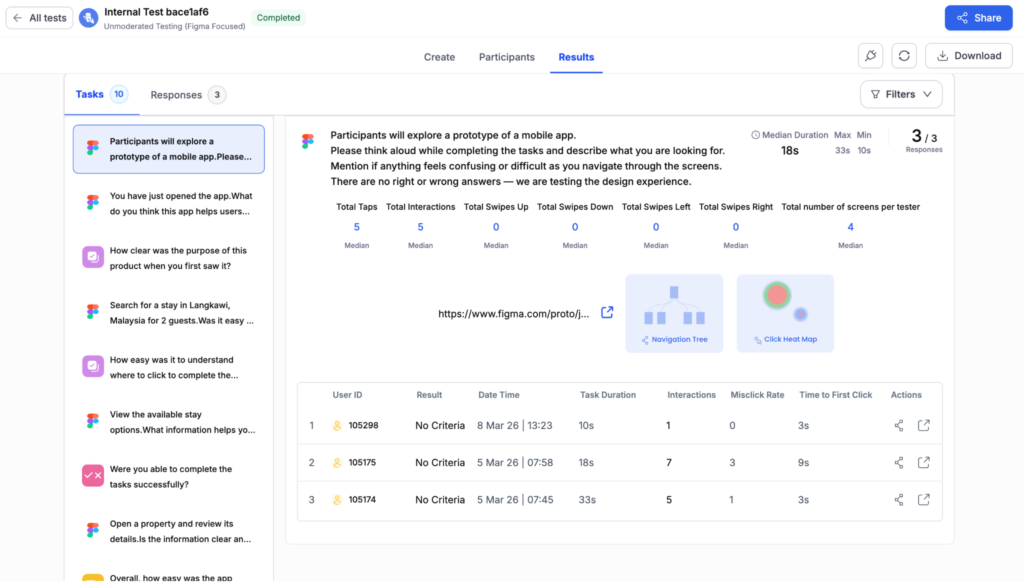
A stalled first click matters more here than a slow overall completion time. It usually means the layout, not the person, is the problem.
What Should You Ask During Pre-Launch Usability and Beta Testing?
Pre-launch user testing questions target the handful of issues that would embarrass you in front of real users, not cosmetic complaints you can fix later. UXArmy’s screen and audio recording captures the exact moment a beta tester hesitates. Questions here should ask what the recording already showed.
A beta tester clicks the wrong button twice in a row during checkout. Instead of asking if checkout felt easy, the researcher asks what she expected to happen after the first click, then plays back the recording to confirm.
Ask these once the recording is rolling:
- What did you expect to happen after you tapped that?
- Was there a point where you almost gave up? What was it?
- How does this compare to the version you use right now?
- If this shipped today, what would stop you from using it?
- What would make you trust this enough to use for real?
A low satisfaction score is easy to shrug off. A stalled click on video, replayed for the team, rarely is.
What Should You Ask After Launch, With Real Users in Production?
Post-launch user testing questions start from a number you already have. A drop-off point in your analytics beats a blank guess every time. UXArmy’s Team Analytics dashboard flags exactly where usage falls off. That turns your next question into a follow-up, not a cold open.
A support ticket mentions the same broken step three times in one week. The team skips a fresh open-ended study. Instead, they pull five recent users through that exact step and ask what they expected at the point they dropped off.
Questions that connect straight to the ticket:
- What were you trying to do right before this happened?
- What did you expect to see on the next screen?
- Have you run into this before, or is this the first time?
- What would you do instead if this feature didn’t exist?
- On a scale of 1 to 5, how well did this match what you needed?
More than half of consumers (52%) stopped buying from a brand after one bad product experience. That’s according to PwC’s 2025 Customer Experience Survey. It’s exactly the risk a post-launch question set is meant to catch early.
How UXArmy Turns the Right Questions Into Faster Launches
A Southeast Asian e-commerce platform serving over 160 million monthly users had a friction point in its login flow. It needed a fix before a regional rollout. The team used UXArmy to run multi-language usability testing across Thailand, the Philippines, and Indonesia, asking stage-specific questions during each round instead of repeating one script.
Research turnaround dropped by 60%, and the redesigned Quick Login flow is projected to raise onboarding completion by up to 15%, per UXArmy’s case study on the project. UXArmy’s screen and audio recording confirmed the rest: exactly where each tester paused.
The single biggest mistake in user testing isn’t a bad question. It’s the right question asked at the wrong stage. A discovery question wasted on a finished build gets you nothing useful.
A task-based question asked before there’s anything to click gets you the same result. Before your next session, check whether your questions are open-ended or closed-ended in a way that matches what you’re trying to learn. So ask yourself: does this session’s question list match what your product can honestly show someone right now?
Ready to Ask Better Questions in Your Next Test?
Every stage in this guide gets easier with a platform built to run it, not read from a script. Run your first stage-specific test with UXArmy and see how screen recording and task logic fill in what a question alone can’t.
Frequently Asked Questions
What questions to ask in user testing?
Ask what someone is trying to accomplish, what they expect to happen next, and why they picked one option over another, three core prompts that work at almost any stage. Skip yes/no questions like “was that easy,” since they invite a polite answer, not the real story.
What are the 4 types of usability test questions?
Usability testing typically uses four types: task-based questions that prompt an action, comprehension questions that check understanding, navigation questions that test findability, and satisfaction questions like the Single Ease Question that measure how a completed task felt. Most sessions mix all four rather than relying on just one type.
What are the 5 question survey questions?
A short five-question survey usually covers one screener question, two task or behavior questions, one satisfaction rating, and one open-ended follow-up asking what would change their answer. Five questions keep completion rates high, though teams often find the open-ended one raises more questions than it settles.
What are the three types of user testing?
The three main types are moderated testing, where a researcher guides the session live; unmoderated testing, where a participant completes tasks alone, and results are reviewed later; and hybrid testing, which often runs an unmoderated round first, then follows up live with the users who struggled most.
What is the 5-second test in user testing?
A 5-second test shows a screen for five seconds, then asks what someone remembers, testing whether your main message lands before anyone reads closely. It’s common in early prototype rounds, though teams sometimes run one on a live page and get a result that contradicts months of prior testing.