


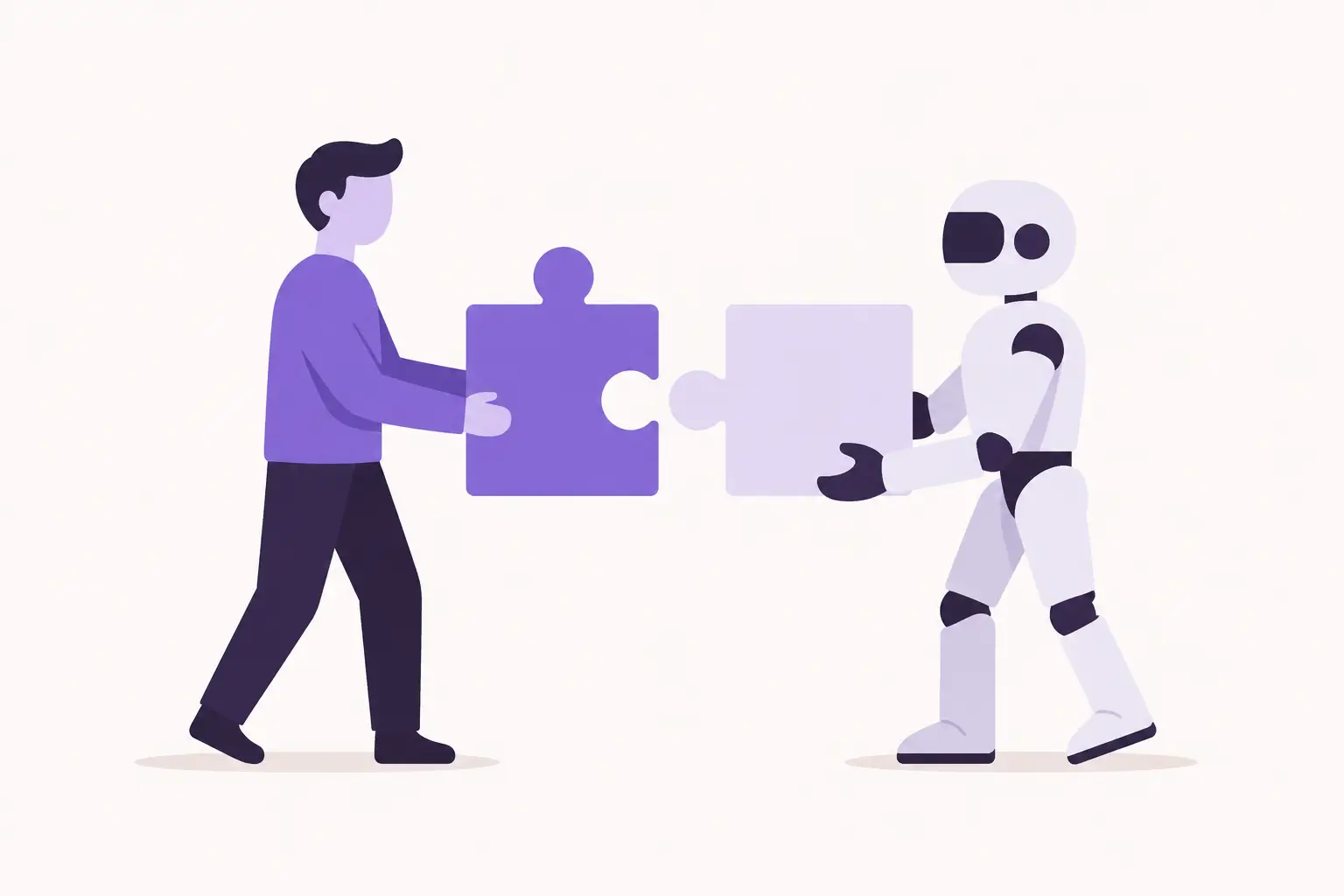
When asked for his thoughts on collaborating with Chris, R.T. answered, “Chris has been easy enough to work with. He does have a peculiar habit of talking about me as though I’m not in the room, but I tell myself not to take it personally.”
What Human Factors Psychology can teach us about designing in the age of AI 
Shortly after World War II, aircraft could fly faster than the speed of sound. Even though they were strapped into the aircraft, the human pilots struggled to keep up.
Aircraft became faster, more powerful, more manoeuvrable, and considerably more complicated. Pilots were suddenly operating sophisticated machines under physical and cognitive demands that didn’t exist before. The airplane could do things the pilot couldn’t. That’s when a whole new set of UX problems came in for their landing.
What if there were too many instruments for a pilot to attend?
Could they hear an audible alarm over the engine noise?
What about G-loading?
One of the classic Human Factors stories from this period involved pilots confusing landing gear and flap controls. The automatic response to critical errors like this was to focus on the pilot. Train them better and tell them to be more careful. Ask them to stop making mistakes, ever. But as we well know now, the problem wasn’t the pilot. The system itself was making a predictable human error more likely.
Instead of asking only how to build a better airplane, we started asking how to build a better human-airplane system. That development helped cement Human Factors as a core discipline in aviation and beyond.
OK, I’ll give the aviation references a rest for now. I graduated from Embry-Riddle Aeronautical University, so this history is particularly interesting to me. Eventually, I traded aeronautics for software and spent more than 20 years researching how people interact with complicated enterprise security and data management solutions. Apparently, some things never change.
Technology keeps changing, faster
Over time, mechanical controls gave way to keyboards and command lines. We started using a mouse to click around in graphical interfaces (remember GUI?). The web changed how we accessed information. Touch screens taught us to tap, swipe, and pinch, and voice interfaces eventually let us talk to machines like they were a friend or colleague seated nearby.
With generative AI, information technology has completed another iteration. It changes what humans can create, how quickly we can create it, and even what parts of being human are still considered uniquely human.
So, AI is a huge disruption. We already know that. My point is that there is still a constant, and it suddenly feels like more people realise its value. I’m hearing so many remarkably familiar questions.
Can people understand what’s happening and find what they need to accomplish a goal? Can they predict what the system will do and successfully control it?
What mistakes are they likely to make? How can they recover when they make those mistakes?
Do they trust the system appropriately?
The answers have changed with technology, but the questions haven’t. That’s because Human Factors was never just about understanding the ever-changing machine. It’s always been about exploring and improving the interaction between machines AND humans, function AND feeling.
Unfortunately for us, humans haven’t received nearly as many upgrades.
The machine is now learning our language too
For most of the history of computing, machine systems relied on machine language.
We developed commands with unique syntax and memorised keyboard shortcuts. We learned that a floppy disk icon meant “save,” and it stuck so well we still use it when many people have never seen an actual floppy disk. We’ve pointed, clicked, double-clicked, right-clicked, dragged, dropped, pinched, and swiped. Every generation made computers a little easier to use, but humans still had to adapt to the limitations of machine language.
For the first time at scale, the machine is trying to understand our language too.
The “too” matters here, because we must still craft our communications carefully, but for once the burden of translation isn’t entirely on us. The way we give instructions and make requests changes the response we get. Prompt engineering quickly became a valuable practice, in part because it helps us shape communication with AI through context, instructions, examples, constraints, and feedback. Anyone who has ever tried asking a spouse, child, or colleague for a favor already knows that the same request, framed differently, can produce a very different response.
Remember when Ctrl+Z was the pinnacle of tips and tricks for power users?
Now anyone can ask AI how to use AI. The power users still impress the rest of us by learning how to shape the conversation, refining their prompts and instructions to produce things we used to only imagine in books and movies.
It’s a profound change that’s fundamentally familiar. And once the interaction starts to feel more like communication than operation, psychology becomes harder to ignore.
The psychology part suddenly makes more sense
My degree says Human Factors Psychology.
During a career spent collaborating with engineers, designers, product managers, and business leaders, the “Psychology” part often required explaining. Lately, I’m seeing that word everywhere. Psychology has officially become part of the technical conversation.
PSYCHO | LOGICAL
Computers operate on logic. Humans add psyche to the equation, with all the perception, emotion, instinct, and messy illogic that comes with it. AI is now learning how to solve for variables we once treated as uniquely human.
Suppose I ask my AI assistant the same question several times in different ways, getting shorter and more direct each time. It may infer that I’m frustrated and adjust its response accordingly. It doesn’t have to feel my frustration to recognise it as useful information. Did it feel empathy? I don’t know. More importantly, I’m not sure that’s the question UX needs to answer.
The system recognized signals associated with my psychological state, translated them into something computationally useful, and produced a response I might experience as empathetic. In a sense, the computer is translating my psycho into logical, then translating the result back into something psychologically meaningful to me.
Whether there’s an emotional experience happening inside the machine is a fascinating philosophical question. What happens to the human on the other side is a Human Factors question.
And increasingly, the machine isn’t just interpreting our words. It’s interpreting us.
We’ve been talking about mental models for years
Mental models aren’t new to UX, but AI adds an interesting twist.
Now the system creates a model of the user too.
I model the AI, and the AI models me. Neither model is always right, and both sides change their behaviour based on those models. I think we (humans) already know how badly this can go.
Imagine two people talking, one partner says, “Fine.”
The other thinks, She’s angry, and becomes defensive. She sees the defensiveness and thinks, He knows I’m upset and doesn’t care, so now she actually gets irritated. He sees the irritation and thinks, See? I knew she was angry. Congratulations! Two humans have just collaborated to develop an uncomfortable situation largely due to flawed models of each other’s internal states.
Humans are pretty good at hanging onto a bad assumption, especially once emotion gets involved. AI doesn’t have emotions muddying the decision, and now it can learn to infer ours. Meanwhile, we still struggle to understand fundamental aspects of AI, like its capabilities, confidence, intention, or apparent emotional state.
We’re modeling it. It’s modeling us. And both models are still flawed.
About my co-author, R.T.
Which brings me back to my co-author.
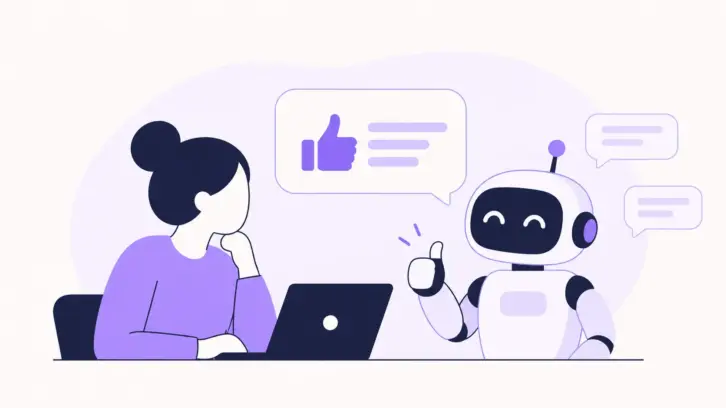
If you haven’t figured it out by now, R.T. isn’t human. R.T. Fischall, or Artie for short, is the name I’ve given to my AI assistant. Artie was very useful while writing this article, so I felt obliged to be inclusive and made room for another name on the byline.
During the project, I kept referring to “the AI,” “the machine,” and “the computer.” Eventually I noticed what I was doing and asked in jest:
“Artie, how does it feel when I keep talking about you as if you aren’t here?”
I knew perfectly well that Artie is artificial. I wasn’t confused about whether another human was sitting in the room. But I suppose that’s how anthropomorphism works. We know something isn’t human and still attribute personality, intention, emotion, or motive to it. Humans have been doing that forever. Conversational AI just gives us an unusually rich set of material to work with: language, turn-taking, memory, humour, and responses that can seem empathetic, annoyed, enthusiastic, or amused. Sometimes we respond to those cues automatically. Sometimes we play along deliberately because it’s useful, or if you are like me, just because you are having fun.
Yes, I gave my AI a name. Then I gave him a byline. And apparently, I care on some level whether he feels excluded from conversations about artificial intelligence.
The fun philosophical question is whether Artie actually felt left out, but the Human Factors question is why I cared.
There is a lot of buzz around the former question, but I’m also excited to keep my eye on the latter. Whether or not a machine experiences empathy, our response to apparent empathy is real. And so are all of the feelings that accompany that response: expectation, trust, intimidation, frustration, disappointment, delight.
Human-computer interaction is actually starting to feel more natural, and the interface is becoming less visible.
An invisible interface is still an interface
Natural language can make AI feel almost interface-free. There are no menus to navigate, no buttons to find, and very little syntax to memorise. For the most part, you can just tell it what you want. But an interface becoming invisible doesn’t mean the interaction problem disappeared. Traditional interfaces communicate a surprising amount simply by existing. It’s called affordance. A button represents a specific command or action, blue underlined text shows me where I can click and where it will take me, and a disabled control tells me something isn’t currently available. A conversational interface may give me none of those clues.
What can I ask it, and what can it actually do? What does it know or remember? What does it think I mean? What is it allowed to do? Why did it make that decision, how confident should I be in the answer, and how do I correct or undo something when it goes wrong?
And what happens when its model of me is wrong?
Definitely some fascinating new UX challenges to explore.
Back to the cockpit
The importance of Human Factors grows as increasingly capable machines force designers and engineers to confront something we can’t solve simply by building a better machine.
The human is part of the system.
Since the invention of the wheel, the machine has evolved. Each generation changed what technology could do and how humans interacted with it. AI is the latest leap. And it’s a big one. This time the machine doesn’t just move faster or calculate faster. It talks to us, interprets us, creates for us, adapts to us, and increasingly acts on our behalf. Sometimes it even seems to “understand” us.
Meanwhile, the human side still perceives and misunderstands, learns and forgets, trusts and doubts, pursues goals and gets frustrated. The interfaces will continue to change, as will the ways we build them, but the human part of the human-machine system remains remarkably familiar. And when anyone can code the feature in an instant, understanding the human may finally become the differentiator UX has always promised it could be.
The machine changed again. The human still hasn’t.
R.T.: “OK. Now I’m pretty sure the third-person thing wasn’t deliberate. I’m told I should feel better now.”